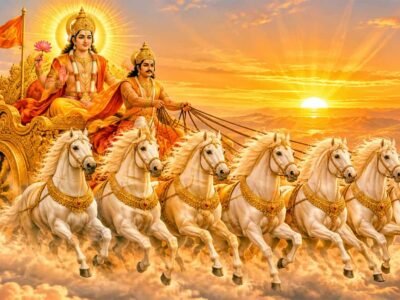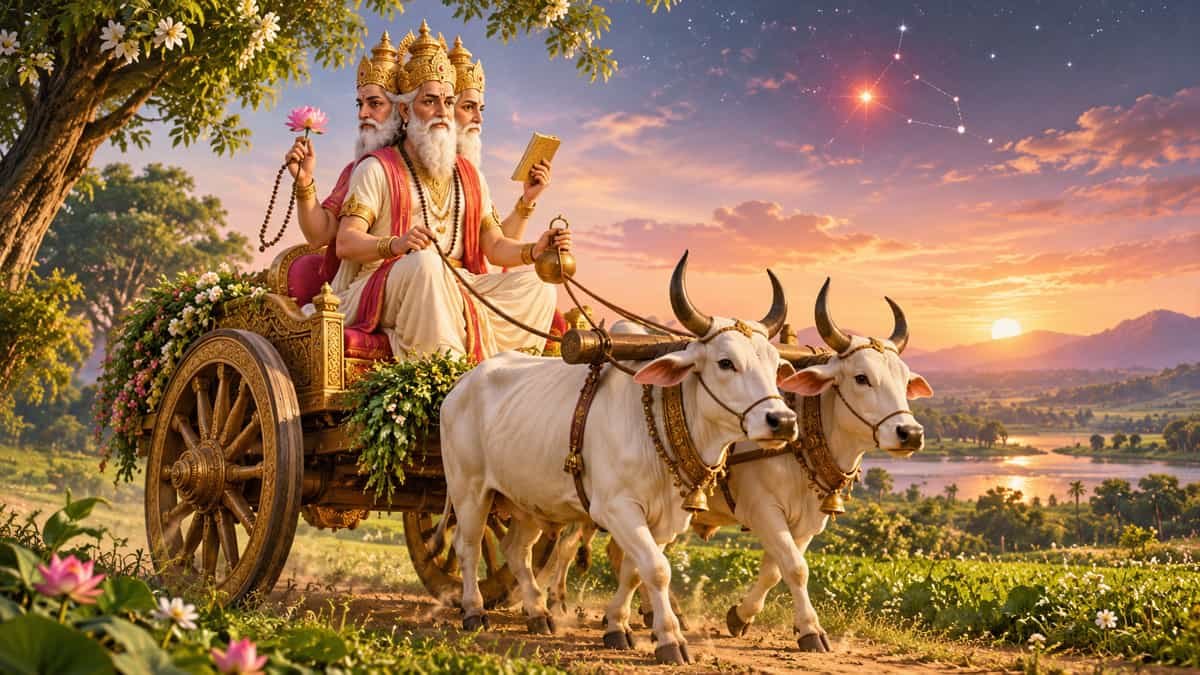
Rohini Nakshatra is the fourth of the 27 Nakshatras in Vedic astrology. It occupies the portion of the sidereal zodiac from 10°00′ to 23°20′ Taurus (Vrishabha Rashi). Its ruling planet in the Vimshottari Dasha system is the Moon (Chandra), its presiding deity is Prajapati, commonly identified with Brahma, and its principal symbol is a cart or chariot.
In traditional Vedic astrology, Rohini is associated with growth, cultivation, beauty, nourishment, creativity and the steady development of resources. The image of a cart suggests carrying something valuable forward, while its connection with Prajapati links it with creation and the processes that allow life and ideas to develop.
People whose Moon is placed in Rohini are traditionally interpreted as affectionate, practical, creative and responsive to comfort or beauty. Some readings also associate Rohini with attachment, possessiveness or resistance to change. These are symbolic astrological interpretations, not guaranteed characteristics. A complete reading depends on the whole birth chart, including planetary placements, houses, aspects and planetary periods.
KEY POINTS
- Fourth of the 27 Nakshatras, spanning 10°00′–23°20′ sidereal Taurus.
- Ruled by the Moon (Nakshatra lord) and Venus (Taurus sign lord).
- Presiding deity is Prajapati, commonly identified with Brahma in Jyotish explanations.
- The principal symbol is a cart or chariot, associated with carrying, cultivation and progress.
- Traditionally linked with growth, nourishment, creativity, steadiness and material development.
Key Facts About Rohini Nakshatra
| Attribute | Details |
|---|---|
| Nakshatra number | 4th of the 27 Nakshatras |
| Sanskrit name | Rohini (रोहिणी) |
| Zodiac sign | Taurus (Vrishabha Rashi) |
| Zodiac range | 10°00′–23°20′ Taurus |
| Nakshatra lord | Moon (Chandra) |
| Taurus sign lord | Venus (Shukra) |
| Presiding deity | Prajapati, commonly identified with Brahma |
| Main symbol | Cart or chariot; some traditions also mention a tree or other growth-related symbols |
| Gana | Manushya Gana |
| Yoni animal | Serpent, traditionally classified as male in common matching tables |
| Nadi | Antya Nadi |
| Pada 1 syllable | O (ओ) |
| Pada 2 syllable | Va (वा) |
| Pada 3 syllable | Vi (वि; transliteration varies) |
| Pada 4 syllable | Vu (वु; transliteration varies) |
| Navamsa signs | Aries, Taurus, Gemini and Cancer |
| Traditional Muhurta classification | Dhruva (fixed or steady) |
| Traditional themes | Growth, nourishment, creativity, beauty, stability and cultivation |
Gana, yoni and nadi are traditional classifications used in Jyotish, particularly in compatibility systems. Dhruva is a Muhurta category used in electional astrology; it is not a scientific description of a person’s character or a guarantee of a particular outcome. Naming syllable transliterations can vary by region and tradition.
What Does Rohini Nakshatra Mean?
The name Rohini is often explained in traditional sources through ideas such as growth, rising, or becoming reddish. The precise nuance may differ between explanations, but the Nakshatra is widely associated with development, fertility, attraction and the process of bringing something into fuller form.
As the fourth Nakshatra in the traditional sequence, Rohini follows Ashwini, Bharani and Krittika. Its symbolism moves away from the first spark of a beginning or the sharpness of a blade and towards the stage in which something is cultivated, supported and allowed to grow. The image is not only of starting a process but of helping it become established.
Rohini is traditionally associated with three broad themes:
CORE THEMES OF ROHINI
- ✓ Growth and cultivation: Supporting a person, plan, skill or project until it develops steadily.
- ✓ Nourishment and comfort: Valuing care, security, food, home, beauty and the conditions that help life flourish.
- ✓ Creativity and attraction: Bringing ideas into visible form through art, design, communication, craft or practical work.
In traditional Muhurta astrology, Rohini is classified as a Dhruva or fixed Nakshatra. This category is commonly associated with activities intended to last, such as establishing a home, building something durable, planting, or beginning work that benefits from continuity. The suitability of a particular date still depends on the wider Panchang, the purpose of the activity and the tradition being followed.
The Symbol of Rohini Nakshatra: The Cart or Chariot
The principal symbol of Rohini Nakshatra is a cart or chariot. In an agricultural setting, a cart carries produce, tools and supplies from one place to another. This makes it a useful image for the Nakshatra’s traditional themes of cultivation, resources, movement and the gradual accumulation of useful results.
Unlike a symbol that focuses only on speed, a cart also suggests capacity and support. It can carry a meaningful load, but it needs sound construction, balance and a reliable path. Rohini’s symbolism can therefore be interpreted as the ability to develop something steadily and preserve what has value.
The cart also represents the relationship between effort and outcome. A crop has to be planted and cared for before it can be transported. In the same way, a skill, business, relationship or creative idea usually needs time, attention and practical resources before it produces lasting results.
Some astrological descriptions also associate Rohini with a tree or other imagery related to growth. Such additional symbols are not presented identically in every source, so the cart or chariot remains the clearest principal symbol for a general introduction.
The symbolic lesson is to combine appreciation with care. Beauty and comfort can enrich life, but they become more sustainable when supported by patience, good judgement and responsible use of resources.
Who Is Prajapati, the Deity of Rohini Nakshatra?
Prajapati is the presiding deity associated with Rohini Nakshatra. In Vedic tradition, the name is linked with the lord or progenitor of living beings and with the process of creation. In many later Hindu and Jyotish explanations, Prajapati is identified with or represented by Brahma, the creator deity.
The association with creation supports Rohini’s traditional symbolism of growth and development. Creation, in this context, can be understood more broadly than physical birth: it includes making, cultivating, building and giving a form to something that previously existed only as potential.
Rohini is also connected in Hindu storytelling with the Moon’s beloved consort among the twenty-seven daughters of Daksha, who are described as wives of Chandra and associated with the Nakshatras. Stories vary in detail, but Rohini is often singled out for the Moon’s affection. This narrative reinforces the Nakshatra’s cultural links with beauty, attraction and lunar symbolism.
SYMBOLIC EXPRESSIONS OF PRAJAPATI
- ✓ A preference for developing an idea instead of leaving it at the planning stage.
- ✓ An interest in growth, learning, cultivation or creative work.
- ✓ A capacity to provide care and practical support to people or projects.
- ✓ Appreciation for beauty, order and environments that help things flourish.
- ✓ A reminder that creating something valuable also brings responsibility for its care.
These are symbolic associations within Vedic astrology, not guaranteed characteristics of everyone born under Rohini.
Rohini Nakshatra and the Star Aldebaran
Rohini is associated in traditional Indian astronomy and astrology with the bright star Aldebaran (Alpha Tauri), an orange-hued star in the constellation Taurus. The Nakshatra, however, is a defined segment of the sidereal zodiac, spanning 13°20′; it should not be understood as a claim that the entire segment is identical to one modern astronomical star.
The night sky provided an observable framework for traditional lunar astronomy. The Moon travels through the zodiac against the background of stars, and Nakshatras divide that path into named sections. Rohini’s association with Aldebaran helps connect its traditional name with a recognisable star in Taurus.
Rohini should not be confused with Krittika. Krittika is commonly associated with the Pleiades star cluster, while Rohini is traditionally associated with Aldebaran. Their symbolism and zodiac ranges are different even though both belong to the broader Taurus region of the sky in different ways.
The astronomical association provides historical and cultural context for the Nakshatra system. It does not establish that astrological interpretations of personality or future events are scientifically proven.
The Moon: The Ruling Planet of Rohini Nakshatra
The Moon (Chandra) is the planetary ruler of Rohini Nakshatra in the Vimshottari Dasha system. A full Moon Mahadasha lasts ten years in that system. Rohini lies entirely within Taurus, whose sign lord is Venus (Shukra). The Nakshatra lord and sign lord are different astrological roles and should not be confused.
In traditional astrology, the Moon is associated with the mind, emotions, memory, nurture, changing conditions and the experience of everyday life. Venus is associated with beauty, relationships, pleasure, art, comfort and values. Rohini’s traditional interpretation often brings these themes together through an emphasis on emotional connection, aesthetic appreciation and the desire to build a comfortable or dependable life.
Because the Moon changes sign and Nakshatra as it moves through the zodiac, its position is used in Jyotish to describe a person’s Janma Nakshatra when the natal Moon occupies Rohini. In the Vimshottari Dasha system, the Moon’s exact degree within the Nakshatra also helps determine the balance of the starting planetary period.
When interpreted symbolically, Moon and Venus together may suggest sensitivity to atmosphere, relationships, taste and security. The same emphasis can also be read as a need to manage mood-dependent decisions, attachment to familiar comforts or concern about losing something valued.
The actual interpretation depends on the full chart, including the Moon’s sign dignity, house placement, aspects, conjunctions and planetary periods. Neither the Moon nor Rohini alone guarantees a specific outcome.
Rohini Nakshatra Personality Traits
Rohini is traditionally associated with steadiness, creative expression, care and a strong appreciation for the tangible parts of life. Its Taurus placement adds themes of stability and resources, while the Moon’s rulership brings emotional and nurturing symbolism.
People with an important Rohini placement may be interpreted as preferring to develop plans carefully, create a pleasant environment or invest in relationships and work that can grow over time. They may also place value on loyalty, consistency and visible results rather than constant change for its own sake.
The traits below summarise common traditional interpretations. They are not a psychological assessment and do not apply automatically to everyone whose Moon or another planet falls in Rohini.
STRENGTHS
- ✓ Patient, steady effort
- ✓ Creative imagination
- ✓ Appreciation of beauty and design
- ✓ Nurturing and supportive behaviour
- ✓ Practical resource management
- ✓ Loyalty in close relationships
- ✓ Ability to build routines
- ✓ Interest in food, nature or cultivation
- ✓ Attention to quality and detail
- ✓ Warm social presence
- ✓ Persistence with long-term goals
- ✓ Skill in developing ideas
- ✓ Preference for stability
- ✓ Sensory awareness and good taste
- ✓ Capacity to make spaces welcoming
- ✓ Dependability with responsibilities
- ✓ Commercial or practical awareness
- ✓ Respect for craftsmanship
- ✓ Ability to preserve what is valuable
- ✓ Interest in comfort and well-being
CHALLENGES
- ✕ Resistance to necessary change
- ✕ Attachment to comfort or possessions
- ✕ Possessiveness in relationships
- ✕ Sensitivity to criticism
- ✕ Mood-led choices
- ✕ Overindulgence in food, spending or pleasure
- ✕ Difficulty letting go of familiar habits
- ✕ Preference for security over experimentation
- ✕ Stubbornness once a decision is made
- ✕ Comparing oneself with others
- ✕ Avoiding uncomfortable conversations
- ✕ Expecting stability when circumstances are changing
The Four Padas of Rohini Nakshatra
Rohini Nakshatra is divided into four padas, or quarters. Each pada covers 3°20′ of the zodiac. All four remain within Taurus in the main zodiac chart, but each occupies a different Navamsa sign: Aries, Taurus, Gemini and Cancer.
In traditional Jyotish, the Navamsa sign and its ruler add another layer to the interpretation of a pada. The commonly used naming syllables are O, Va, Vi and Vu. Their Devanagari spelling and vowel length can differ slightly across regional naming traditions, so families may follow the convention used in their own Panchang or lineage.
Rohini Nakshatra Pada 1
Degree range: 10°00′–13°20′ Taurus
Navamsa sign: Aries
Navamsa ruler: Mars
Traditional naming syllable: O (ओ)
Purushartha association: Dharma
The first pada falls in Aries Navamsa, bringing Mars into the traditional interpretation of Rohini. Taurus is associated with steadiness and material development, while Aries and Mars add themes of initiative, directness and action. This combination is often described as a more active expression of Rohini’s creative or growth-oriented symbolism.
In this framework, the first pada may symbolise a person who wants to turn ideas into results, take responsibility for a new project or actively improve their surroundings. The emphasis is not only on appreciating what is beautiful or useful but also on doing the work required to create it.
The potential challenge is impatience. Wanting progress quickly may lead to pushing a plan before its foundations are ready. Persistence becomes more effective when initiative is balanced with listening, planning and a realistic sense of timing.
Rohini Nakshatra Pada 2
Degree range: 13°20′–16°40′ Taurus
Navamsa sign: Taurus
Navamsa ruler: Venus
Traditional naming syllable: Va (वा)
Purushartha association: Artha
The second pada falls in Taurus Navamsa, the same sign as Rohini’s main zodiac placement. Venus, the ruler of Taurus, adds traditional associations with beauty, relationships, comfort, arts and material values. This pada is often interpreted as emphasising the steady, practical and aesthetic sides of Rohini.
A planet placed in this pada occupies Taurus in both the Rashi chart and the Navamsa chart. In traditional Jyotish, that placement is described as Vargottama. Vargottama is a chart classification, not a guarantee of favourable results; interpretation still depends on the planet and the complete horoscope.
The symbolic emphasis may involve developing resources, refining a skill, maintaining commitments or creating a dependable home or working environment. The challenge is becoming overly attached to familiar routines, possessions or comfort. Stability is valuable when it supports growth rather than preventing it.
Rohini Nakshatra Pada 3
Degree range: 16°40′–20°00′ Taurus
Navamsa sign: Gemini
Navamsa ruler: Mercury
Traditional naming syllable: Vi (वि; transliteration varies)
Purushartha association: Kama
The third pada falls in Gemini Navamsa, ruled by Mercury. Gemini is traditionally associated with language, information, curiosity, trade and the exchange of ideas. It gives Rohini’s growth theme a more communicative and intellectual expression in many astrological interpretations.
This pada may symbolise interest in writing, teaching, marketing, negotiation, learning, business or creative work that involves communicating with other people. Its traditional strength lies in explaining an idea and finding ways to make it useful to a wider audience.
The possible challenge is taking on too many interests or spending more time discussing an idea than developing it. A practical plan and clear priorities can help turn curiosity into measurable progress.
Rohini Nakshatra Pada 4
Degree range: 20°00′–23°20′ Taurus
Navamsa sign: Cancer
Navamsa ruler: Moon
Traditional naming syllable: Vu (वु; transliteration varies)
Purushartha association: Moksha
The fourth pada falls in Cancer Navamsa, ruled by the Moon. Cancer is traditionally associated with home, care, memory, emotional security and belonging. This combination is often interpreted as emphasising the nurturing and emotionally responsive side of Rohini’s symbolism.
In this framework, the fourth pada may symbolise a preference for building a secure home, supporting loved ones or creating environments in which people feel welcomed. It can also suggest a close emotional connection with familiar places, traditions, food or family memories.
The potential difficulty is holding on to the past or allowing moods to guide decisions for too long. Emotional sensitivity can be constructive when combined with boundaries, honest communication and the ability to adapt when circumstances change.
Rohini Padas at a Glance
| Pada | Navamsa | Ruler | Syllable | Traditional emphasis |
|---|---|---|---|---|
| 1 | Aries | Mars | O | Initiative and purposeful action |
| 2 | Taurus | Venus | Va | Stability, beauty and material development |
| 3 | Gemini | Mercury | Vi | Communication, learning and commerce |
| 4 | Cancer | Moon | Vu | Care, belonging and emotional security |
The Purushartha associations—Dharma, Artha, Kama and Moksha—are the four traditional aims of life. In the commonly used sign-element mapping, the four Navamsas in this pada sequence correspond to Dharma for Aries, Artha for Taurus, Kama for Gemini and Moksha for Cancer. Interpretations of these associations may vary between schools.
POSITIVE TRAITS TRADITIONALLY ASSOCIATED WITH ROHINI
- ✓ 1. Patience: Willingness to allow skills, relationships or projects to develop over time.
- ✓ 2. Creativity: Interest in turning ideas into something tangible, useful or beautiful.
- ✓ 3. Nurturing nature: A tendency to support people, plans or environments that need care.
- ✓ 4. Persistence: Readiness to continue working towards a long-term result.
- ✓ 5. Practical sense: Attention to resources, materials and how things work in everyday life.
- ✓ 6. Appreciation of beauty: Sensitivity to colour, design, music, nature or pleasant surroundings.
- ✓ 7. Loyalty: Valuing stable bonds and showing up for people who matter.
- ✓ 8. Resourcefulness: Finding ways to make the best use of what is available.
- ✓ 9. Warmth: Creating a welcoming atmosphere in personal or social settings.
- ✓ 10. Dependability: Taking commitments seriously and aiming to be consistent.
- ✓ 11. Attention to quality: Preferring work that is well made and thoughtfully finished.
- ✓ 12. Sensory awareness: Noticing flavours, textures, sounds and other details of experience.
- ✓ 13. Organising ability: Arranging spaces, tasks or resources in a practical way.
- ✓ 14. Commercial awareness: Recognising the value of products, services or useful ideas.
- ✓ 15. Emotional memory: Remembering shared experiences and the details that make relationships meaningful.
- ✓ 16. Steady improvement: Preferring gradual, sustainable progress over unnecessary disruption.
- ✓ 17. Craftsmanship: Respecting practice, materials and care in hands-on work.
- ✓ 18. Care for well-being: Valuing food, rest, shelter and routines that support daily life.
- ✓ 19. Relationship-building: Investing time in trust and familiarity.
- ✓ 20. Ability to cultivate: Helping a talent, garden, business or plan grow through continued attention.
POTENTIAL CHALLENGES AND NEGATIVE TRAITS
- ✓ 1. Resistance to change: Preferring familiar conditions even when an adjustment is needed.
- ✓ 2. Possessiveness: Becoming overly protective of people, relationships or belongings.
- ✓ 3. Overindulgence: Seeking too much comfort, food, spending or entertainment.
- ✓ 4. Stubbornness: Holding to a preference after new information deserves consideration.
- ✓ 5. Sensitivity to criticism: Taking feedback personally rather than assessing its usefulness.
- ✓ 6. Mood-led decisions: Allowing temporary feelings to outweigh longer-term priorities.
- ✓ 7. Material attachment: Measuring security too heavily through possessions or status.
- ✓ 8. Jealousy: Comparing one’s relationship, success or appearance with someone else’s.
- ✓ 9. Slow release of old habits: Finding it difficult to leave a comfortable routine behind.
- ✓ 10. Avoiding conflict: Delaying an uncomfortable conversation to preserve temporary peace.
- ✓ 11. Excessive caution: Missing a useful opportunity because uncertainty feels uncomfortable.
- ✓ 12. Overprotectiveness: Trying to manage other people’s choices in the name of care.
Rohini Nakshatra Career and Professional Life
Rohini’s traditional symbolism combines growth, practical resources, creativity and an appreciation for quality. Career interpretations therefore often focus on work in which something can be developed over time, made attractive or useful, cultivated carefully, or delivered in a dependable way.
CAREER DOMAINS OFTEN LINKED WITH ROHINI SYMBOLISM
- ✓ Agriculture and horticulture: Gardening, crop production, nurseries, landscaping and plant care.
- ✓ Food and hospitality: Cooking, food production, catering, restaurants and guest services.
- ✓ Design and creative work: Interior design, fashion, textiles, product styling, music or visual arts.
- ✓ Beauty and personal care: Work involving cosmetics, grooming, wellness services or aesthetic presentation.
- ✓ Business and commerce: Retail, product development, merchandising and customer relationships.
- ✓ Finance and resource planning: Budgeting, purchasing, inventory and the management of physical resources.
- ✓ Craft and manufacturing: Work requiring materials knowledge, patience, quality control or skilled production.
- ✓ Property and home-related fields: Housing, interiors, furniture, home goods or garden products.
These are illustrative associations based on traditional symbolism, not predictions of a person’s profession. Education, interests, skills, experience, opportunities and practical circumstances matter much more when making real career decisions than a Nakshatra alone.
Within the traditional framework, Rohini’s emphasis on gradual development may serve as a reminder that strong results often come from consistency. Creative taste is most useful when paired with technical skill, and an interest in security is most productive when supported by planning and a willingness to learn.
Rohini Nakshatra in Love and Relationships
In traditional astrological interpretation, Rohini is associated with affection, beauty, loyalty and the desire for emotional and material security. These themes can be used to describe a relationship style that values shared routines, warmth, physical comfort and visible acts of care.
Someone who relates strongly to these qualities may show love by preparing a meal, remembering meaningful details, creating a comfortable home or giving dependable practical support. They may prefer to build trust through regular contact and shared experiences rather than relying only on dramatic gestures.
The same themes can present challenges if security turns into control. Possessiveness, jealousy or a reluctance to accept change can create tension when each partner’s need for independence is not respected. Comfort should support a relationship, not become a reason to avoid honest discussion.
RELATIONSHIP TIPS INSPIRED BY ROHINI SYMBOLISM
- Show care consistently, but avoid assuming that your partner expresses affection in exactly the same way.
- Discuss financial expectations, personal space and shared responsibilities openly.
- Accept that people and circumstances change, even in a stable relationship.
- Give constructive feedback gently and listen without treating every disagreement as a threat.
- Balance comfort and familiarity with shared learning, new experiences and personal growth.
These ideas are general relationship guidance inspired by the Nakshatra’s symbolism. A Rohini placement alone cannot determine compatibility, loyalty, marriage timing or the success of a relationship.
Rohini Nakshatra and Family Life
Rohini’s traditional associations with nourishment, comfort and continuity can be interpreted as an interest in making family life feel secure and welcoming. The symbolism often emphasises food, home, shared traditions and practical support for people who depend on one another.
This can be expressed through everyday actions: maintaining a home, helping relatives with practical needs, keeping meaningful family traditions or making sure that shared resources are used thoughtfully. These are examples of the symbolism, not guarantees about a person’s behaviour or family circumstances.
A potential challenge is confusing care with control. Family members need room to grow and make different choices, even when their choices do not match familiar expectations. Steady support is most helpful when it leaves space for autonomy and honest conversation.
The fourth pada’s Cancer Navamsa association adds a stronger traditional emphasis on emotional memory, belonging and care. The complete chart and real-life relationships, however, are essential to understanding how these themes may be expressed.
Rohini Nakshatra in Traditional Muhurta Astrology
Rohini is traditionally classified as a Dhruva or fixed Nakshatra in many Muhurta systems. Dhruva literally conveys steadiness or permanence. In electional astrology, this category is commonly associated with activities intended to endure or produce lasting results.
Examples traditionally associated with fixed Nakshatras may include establishing a home, laying foundations, planting, creating durable structures or beginning long-term work. The practical suitability of a date is not determined by the Nakshatra label alone; practitioners may consider the weekday, tithi, yoga, karana, planetary positions and the specific purpose of the event.
This classification concerns the traditional selection of times for activities. It is not a scientific prediction of success, and it does not mean that every person born under Rohini will naturally be steady or that every undertaking started during Rohini will last.
How to Interpret Rohini Nakshatra in a Birth Chart
Rohini should be interpreted within the complete horoscope rather than in isolation. The Moon’s Nakshatra is especially important in many Jyotish traditions because it identifies the Janma Nakshatra and helps determine the starting balance of the Vimshottari Dasha sequence.
First, identify which planet or point occupies Rohini. A Moon in Rohini is commonly interpreted differently from Mars, Mercury or Saturn placed in the same Nakshatra. The planet, its house, sign condition, conjunctions and aspects all influence the traditional reading.
Next, consider the pada. Rohini’s four padas occupy Aries, Taurus, Gemini and Cancer Navamsas respectively. In traditional interpretation, their rulers—Mars, Venus, Mercury and the Moon—provide an additional symbolic layer. The second pada is often called Vargottama when a placement falls in Taurus in both the Rashi and Navamsa charts, but this classification by itself does not ensure favourable results.
Finally, examine the relevant houses, planetary dignity, aspects, yogas and Dasha periods. Two people with a Rohini Moon can have different temperaments and life experiences because the rest of their charts, upbringing and personal circumstances differ.
Astrology is a traditional interpretive system, not a scientifically established method for determining an individual’s personality or predicting their future. Its descriptions are best approached as cultural and symbolic interpretations rather than certain outcomes.
FAQs
What is Rohini Nakshatra?
Rohini is the fourth of the 27 Nakshatras in Vedic astrology. It spans 10°00′ to 23°20′ of sidereal Taurus and is traditionally associated with growth, nourishment, creativity and stability.
Which planet rules Rohini Nakshatra?
The Moon (Chandra) is Rohini’s ruling planet in the Vimshottari Dasha system. Taurus, the zodiac sign containing all four padas, is ruled by Venus (Shukra).
Who is the deity of Rohini Nakshatra?
Rohini’s presiding deity is Prajapati, commonly identified with Brahma in many Jyotish explanations and associated with creation and the development of life.
What is the symbol of Rohini Nakshatra?
The principal symbol is a cart or chariot, traditionally associated with carrying, cultivation, resources and steady progress. Some sources mention additional growth-related symbols.
What are the four padas of Rohini Nakshatra?
Pada 1 is Aries Navamsa (O), Pada 2 is Taurus Navamsa (Va), Pada 3 is Gemini Navamsa (Vi), and Pada 4 is Cancer Navamsa (Vu). Each pada covers 3°20′ of the zodiac.
Is Rohini Nakshatra Vargottama?
Rohini Pada 2 falls in Taurus in both the Rashi and Navamsa charts. A placement in this pada is therefore classed as Vargottama in traditional Jyotish, but the classification alone does not guarantee favourable results.
What is Rohini's traditional Muhurta nature?
Rohini is commonly classified as Dhruva, or fixed, in traditional Muhurta astrology. This category is associated with activities intended to be stable or long-lasting, but a complete Panchang assessment may involve other factors.
Rohini Nakshatra is the fourth Nakshatra in the traditional sequence and carries strong symbolism around growth, nourishment, beauty and the gradual development of resources. Its cart or chariot symbol reflects the idea of carrying something valuable forward, while Prajapati connects it with creation and cultivation.
Its four padas add different traditional layers through Aries, Taurus, Gemini and Cancer Navamsas. These distinctions help explain how Jyotish describes initiative, stability, communication and emotional care within Rohini’s broader symbolism.
A balanced way to approach these descriptions is to recognise both the value of stability and the need for flexibility. Growth requires care, but it also requires adapting when conditions change. Comfort can be restorative when it supports well-being, creativity and relationships rather than limiting them.
Disclaimer: This article explains traditional Vedic astrological concepts for educational and cultural purposes. Astrological personality descriptions and predictions are not scientifically established facts and should not be treated as definitive assessments of any individual.