
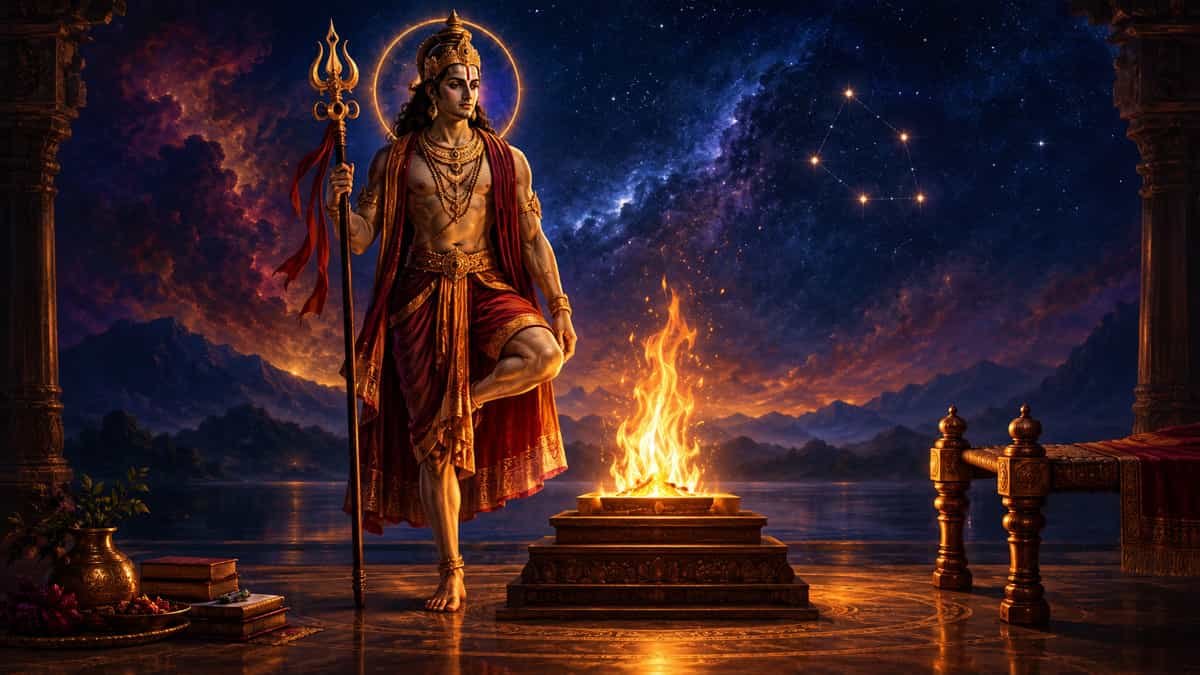
Purva Bhadrapada Nakshatra is the 25th of the 27 Nakshatras in Vedic astrology. It spans 20°00′ Aquarius (Kumbha Rashi) to 3°20′ Pisces (Meena Rashi), crossing the boundary between these two sidereal zodiac signs. Its ruling planet in the Vimshottari Dasha system is Jupiter, its presiding deity is Aja Ekapada, and its principal symbols include the front legs of a funeral cot and a sword.
In traditional Jyotish, Purva Bhadrapada is associated with intensity, conviction, spiritual inquiry, transformation and the wish to look beyond appearances. Its symbols can represent the threshold between one state and another, while Aja Ekapada is connected in Hindu tradition with a distinctive, one-footed form associated with Rudra.
People whose Moon is placed in Purva Bhadrapada may be described in traditional astrology as idealistic, thoughtful, determined or drawn to difficult questions. These are symbolic interpretations, not guaranteed personality traits. A full reading depends on the complete birth chart, including planetary placements, houses, aspects and Dasha periods.
KEY TAKEAWAYS
- 25th of the 27 Nakshatras, spanning 20°00′ Aquarius to 3°20′ Pisces.
- Ruled by Jupiter in the Vimshottari Dasha system; Saturn and Jupiter are the sign lords of its Aquarius and Pisces portions.
- Presiding deity is Aja Ekapada; symbols include the front legs of a funeral cot and a sword.
- Traditional themes include conviction, intensity, spiritual inquiry, transformation and perseverance.
Key Facts About Purva Bhadrapada Nakshatra
| Attribute | Details |
|---|---|
| Nakshatra number | 25th of the 27 Nakshatras |
| Sanskrit name | Purva Bhadrapada (पूर्वभाद्रपदा); also written Purva Bhadrapada or Purvabhadrapada |
| Zodiac signs | Aquarius (Kumbha) and Pisces (Meena) |
| Zodiac range | 20°00′ Aquarius–3°20′ Pisces |
| Nakshatra lord | Jupiter (Guru) |
| Sign lords | Saturn for Aquarius; Jupiter for Pisces |
| Presiding deity | Aja Ekapada |
| Main symbols | Front legs of a funeral cot; sword; in some depictions, a two-faced figure |
| Gana | Manushya Gana in common Jyotish classifications |
| Yoni | Lion, traditionally classified as male |
| Nadi | Adi Nadi |
| Pada 1 syllable | Se (से) |
| Pada 2 syllable | So (सो) |
| Pada 3 syllable | Da / Daa (दा) |
| Pada 4 syllable | Di / Dhi (दी / धी, depending on transliteration tradition) |
| Navamsa signs | Aries, Taurus, Gemini and Cancer |
| Traditional Muhurta nature | Ugra (fierce) in common classifications |
| Traditional themes | Conviction, intensity, inner inquiry, change and spiritual reflection |
Gana, yoni, nadi and Muhurta nature are traditional Jyotish classifications. They are cultural and astrological concepts, not scientific descriptions of a person’s character or destiny. Naming syllables can vary slightly in English transliteration across regional traditions.
What Does Purva Bhadrapada Nakshatra Mean?
The name Purva Bhadrapada is often interpreted as ‘the earlier’ or ‘former auspicious feet’. It forms a pair with Uttara Bhadrapada, the ‘latter’ or ‘latter auspicious feet’. In traditional imagery, the two Nakshatras are associated with the two parts of a cot or bed, an image that can suggest transition, rest, endings and the threshold between different states of life.
Purva Bhadrapada lies partly in Aquarius and partly in Pisces. This boundary is an important practical detail: the first three padas occupy the final 10 degrees of Aquarius, while the fourth pada lies in the opening 3°20′ of Pisces. The main Nakshatra lord remains Jupiter across the full span, but the sign lord changes from Saturn to Jupiter at the Aquarius–Pisces boundary.
Traditional descriptions often associate this Nakshatra with strong beliefs, deep contemplation and the capacity to persist through demanding circumstances. These ideas should be understood as symbolic themes within Jyotish rather than a fixed description of everyone whose Moon occupies this Nakshatra.
CORE THEMES OF PURVA BHADRAPADA
- ✓ Conviction: Holding firmly to a principle or cause while remaining willing to examine new evidence.
- ✓ Inner inquiry: Looking beneath surface explanations and asking difficult questions about life, ethics or meaning.
- ✓ Transformation: Exploring how a major change can alter priorities, identity or understanding.
- ✓ Perseverance: Continuing with a demanding task when it has a clear and considered purpose.
The Symbols of Purva Bhadrapada Nakshatra
The Front Legs of a Funeral Cot
One principal symbol of Purva Bhadrapada is the front part or front legs of a funeral cot. In traditional interpretation, the cot links this Nakshatra with endings, transition and contemplation of mortality. The symbol does not mean that a person born under this Nakshatra is destined for harm; it is an image used to express the seriousness with which this Nakshatra is often interpreted.
A cot can also suggest rest, withdrawal and a pause between one phase and the next. In a symbolic reading, Purva Bhadrapada can represent the process of reflecting on what must be left behind before a new stage begins.
The Sword
A sword is another symbol found in traditional descriptions. It may represent discernment, sharp judgement, courage or the act of cutting through confusion. In balanced expression, this symbolism can suggest the willingness to investigate an issue honestly and make a difficult decision after careful thought.
The same imagery has a cautionary side: strong conviction can become harshness if a person stops listening to others. Traditional interpretations therefore work best when intensity is balanced by compassion, patience and responsibility.
The Two-Faced Figure in Some Depictions
Some astrological depictions associate Purva Bhadrapada with a two-faced figure. This is not used identically in every source, but it is sometimes interpreted as an image of duality: public and private life, material concerns and spiritual questions, or competing ways of viewing the same situation. It should not automatically be read as dishonesty or duplicity in an individual.
Who Is Aja Ekapada, the Deity of Purva Bhadrapada?
Aja Ekapada is the presiding deity associated with Purva Bhadrapada. The name is commonly translated as ‘the one-footed one’, and the deity is linked in Vedic and later Hindu traditions with Rudra-related imagery, cosmic force and a powerful, unusual form. Details and interpretations differ among textual and regional traditions.
The association with Aja Ekapada helps explain why Purva Bhadrapada is often described as intense or spiritually searching. In astrological interpretation, its energy is frequently presented as a force that may be channelled into contemplation, disciplined practice or commitment to a demanding ideal.
SYMBOLIC EXPRESSIONS OF AJA EKAPADA
- ✓ A search for meaning that goes beyond easy answers.
- ✓ A willingness to face difficult questions rather than ignore them.
- ✓ The drive to transform a strongly held idea into deliberate action.
- ✓ An interest in spiritual, philosophical or ethical subjects.
- ✓ A reminder to direct intensity carefully and avoid extremes for their own sake.
These associations belong to traditional religious and astrological interpretation. They are not guaranteed traits of every person associated with Purva Bhadrapada.
Jupiter: The Ruling Planet of Purva Bhadrapada Nakshatra
Jupiter (Guru) is the Nakshatra lord of Purva Bhadrapada in the Vimshottari Dasha system. Jupiter is traditionally linked with wisdom, teaching, ethics, expansive thought, faith and the search for meaning. These themes help frame Purva Bhadrapada as a Nakshatra associated with ideals and deeper questions.
However, Purva Bhadrapada spans two zodiac signs. Saturn rules Aquarius, where the first three padas occur, while Jupiter rules Pisces, where the fourth pada falls. The Nakshatra lord and the zodiac sign lord play different roles in Jyotish, so they should not be treated as interchangeable.
In traditional readings, the combination may be interpreted as conviction supported by reflection and discipline. The possible difficulty is becoming rigid about an ideal, treating disagreement as a personal challenge, or moving between extremes. A balanced interpretation emphasises humility, evidence, proportion and the ability to revise a position.
The actual astrological interpretation depends on Jupiter’s placement and condition, the relevant houses, aspects, the Moon’s position, and the wider chart and Dasha sequence.
Purva Bhadrapada Nakshatra Personality Traits
Traditional Jyotish descriptions often connect Purva Bhadrapada with intensity, independent thinking, idealism and a willingness to examine subjects that others may avoid. Some interpretations emphasise a serious outlook or strong commitment to a cause. These themes are not a psychological test and do not apply uniformly to everyone with this placement.
The balanced expression of these themes may involve careful research, principled action and perseverance. The less balanced expression may involve rigid beliefs, all-or-nothing thinking or a tendency to place too much pressure on oneself or others.
STRENGTHS
- ✓ Strong commitment to principles
- ✓ Deep reflective thinking
- ✓ Interest in philosophy and meaning
- ✓ Perseverance with demanding work
- ✓ Courage to examine difficult issues
- ✓ Independent judgement
- ✓ Capacity for sustained study
- ✓ Concern for ethical questions
- ✓ Ability to rethink old assumptions
- ✓ Determination during change
- ✓ Intellectual curiosity
- ✓ Willingness to challenge superficial answers
- ✓ Long-term focus
- ✓ Seriousness about responsibilities
- ✓ Potential for disciplined spiritual practice
- ✓ Interest in research and analysis
- ✓ Capacity to work independently
- ✓ Strong sense of purpose
- ✓ Ability to plan for major change
- ✓ Persistence in pursuit of a meaningful goal
CHALLENGES
- ✕ Rigid attachment to a belief
- ✕ All-or-nothing thinking
- ✕ Harsh judgement of opposing views
- ✕ Impatience with superficial explanations
- ✕ Overthinking difficult questions
- ✕ Taking on excessive responsibility
- ✕ Difficulty letting go of a past phase
- ✕ Becoming intense when challenged
- ✕ Neglecting everyday needs for an ideal
- ✕ Pessimism during uncertainty
- ✕ Withdrawing instead of explaining feelings
- ✕ Pushing too hard toward a chosen goal
- ✕ Difficulty accepting gradual compromise
- ✕ Treating disagreement as a personal conflict
The Four Padas of Purva Bhadrapada Nakshatra
Purva Bhadrapada is divided into four padas, or quarters, each covering 3°20′. The first three padas are in Aquarius, and the fourth is in Pisces. Each pada occupies a different Navamsa sign, which traditional astrologers use as another layer in interpreting a placement.
The naming syllables commonly used for the four padas are Se, So, Da and Di. Some sources render the last syllables with different vowel lengths or transliterations, such as Daa and Dhi. The degree ranges below follow the standard sidereal zodiac sequence.
Purva Bhadrapada Nakshatra Pada 1
Degree range: 20°00′–23°20′ Aquarius
Navamsa sign: Aries
Navamsa ruler: Mars
Traditional naming syllable: Se (से)
Purushartha association: Dharma
The first pada falls in Aries Navamsa, ruled by Mars. Within traditional interpretation, this combination may place emphasis on initiative, courage and acting on a strongly held idea. It can symbolise a person who prefers to begin a task rather than wait for perfect conditions.
The possible challenge is acting too quickly or turning conviction into confrontation. Preparation, patience and willingness to hear a different view can help balance the symbolism of this pada.
Purva Bhadrapada Nakshatra Pada 2
Degree range: 23°20′–26°40′ Aquarius
Navamsa sign: Taurus
Navamsa ruler: Venus
Traditional naming syllable: So (सो)
Purushartha association: Artha
The second pada falls in Taurus Navamsa, ruled by Venus. Traditional readings may interpret this combination as a desire to give practical form to ideals, build stable resources or create something that lasts. It can balance the Nakshatra’s intensity with a stronger focus on tangible outcomes.
A potential difficulty is holding too tightly to a preferred plan or becoming attached to a particular result. Flexibility can help turn persistence into constructive long-term effort.
Purva Bhadrapada Nakshatra Pada 3
Degree range: 26°40′–30°00′ Aquarius
Navamsa sign: Gemini
Navamsa ruler: Mercury
Traditional naming syllable: Da / Daa (दा)
Purushartha association: Kama
The third pada falls in Gemini Navamsa, ruled by Mercury. Its traditional symbolism may emphasise communication, learning, analysis and the ability to explain complex ideas. It can represent a more verbal or intellectual expression of the Nakshatra’s interest in questions of meaning.
The challenge may be becoming absorbed in theories or arguments while overlooking practical needs. Clear communication is most useful when it remains connected to evidence, empathy and action.
Purva Bhadrapada Nakshatra Pada 4
Degree range: 0°00′–3°20′ Pisces
Navamsa sign: Cancer
Navamsa ruler: Moon
Traditional naming syllable: Di / Dhi (दी / धी)
Purushartha association: Moksha
The fourth pada falls in Cancer Navamsa, ruled by the Moon. Traditional interpretations may give greater emphasis to emotional sensitivity, compassion, imagination and spiritual reflection. It is also the only pada of Purva Bhadrapada that falls in Pisces in the main zodiac chart.
The possible challenge is becoming emotionally overwhelmed by difficult questions or carrying the burdens of others. Healthy boundaries and steady routines can help balance reflection with everyday life.
Purva Bhadrapada Padas at a Glance
| Pada | Main zodiac range | Navamsa | Ruler | Syllable | Traditional emphasis |
|---|---|---|---|---|---|
| 1 | 20°00′–23°20′ Aquarius | Aries | Mars | Se | Initiative and conviction |
| 2 | 23°20′–26°40′ Aquarius | Taurus | Venus | So | Stability and practical outcomes |
| 3 | 26°40′–30°00′ Aquarius | Gemini | Mercury | Da / Daa | Learning and communication |
| 4 | 0°00′–3°20′ Pisces | Cancer | Moon | Di / Dhi | Emotional insight and reflection |
The Purushartha associations—Dharma, Artha, Kama and Moksha—are commonly matched to the four Navamsa signs in this sequence. This is one traditional interpretive framework; astrologers may differ in how they combine pada meanings with a full chart.
Positive Qualities Commonly Associated with Purva Bhadrapada
POSITIVE QUALITIES
- ✓ 1. Conviction: Taking principles and responsibilities seriously.
- ✓ 2. Reflection: Thinking carefully about complex questions.
- ✓ 3. Perseverance: Staying with demanding work when the purpose is clear.
- ✓ 4. Curiosity: Looking beyond surface explanations.
- ✓ 5. Independent judgement: Forming a view after considering available information.
- ✓ 6. Ethical awareness: Asking whether an action is fair and responsible.
- ✓ 7. Research interest: Enjoying detailed investigation and sustained study.
- ✓ 8. Courage: Willingness to face uncomfortable questions.
- ✓ 9. Long-term focus: Keeping wider goals in mind through setbacks.
- ✓ 10. Adaptability through reflection: Revising a view after serious consideration.
- ✓ 11. Intellectual seriousness: Valuing depth over superficial approval.
- ✓ 12. Commitment: Investing effort in a chosen cause or practice.
- ✓ 13. Strategic thinking: Considering consequences before acting.
- ✓ 14. Capacity for solitude: Using quiet time for learning or thought.
- ✓ 15. Interest in spiritual questions: Exploring meaning, ethics and inner development.
- ✓ 16. Resilience during transition: Seeking direction during periods of change.
- ✓ 17. Problem analysis: Breaking difficult issues into parts.
- ✓ 18. Willingness to challenge assumptions: Asking whether familiar ideas still make sense.
- ✓ 19. Self-discipline: Maintaining a practice that supports a meaningful goal.
- ✓ 20. Sense of purpose: Wanting effort to serve something more than immediate reward.
Challenges and Less Balanced Expressions of Purva Bhadrapada
POTENTIAL CHALLENGES
- ✓ 1. Rigidity: Holding on to a belief even when new evidence deserves attention.
- ✓ 2. Extremes: Seeing a situation as entirely right or entirely wrong.
- ✓ 3. Harsh criticism: Expressing conviction without considering the effect on others.
- ✓ 4. Overthinking: Revisiting difficult questions without reaching a practical next step.
- ✓ 5. Impatience: Becoming frustrated when others need more time.
- ✓ 6. Emotional intensity: Allowing a strong reaction to dominate a discussion.
- ✓ 7. Isolation: Withdrawing instead of explaining a concern.
- ✓ 8. Overcommitment: Taking on too much because a cause feels important.
- ✓ 9. Difficulty with uncertainty: Seeking absolute answers when a situation remains complex.
- ✓ 10. Neglecting routine: Focusing on big ideas while practical needs go unattended.
- ✓ 11. Reluctance to compromise: Treating a middle position as a loss of principle.
- ✓ 12. Holding on to the past: Finding it difficult to close an old chapter.
- ✓ 13. Self-imposed pressure: Expecting every decision to carry a larger meaning.
- ✓ 14. Argumentative reactions: Turning disagreement into a contest rather than an exchange of ideas.
Purva Bhadrapada Nakshatra Career and Professional Life
Purva Bhadrapada’s traditional themes of inquiry, conviction and sustained effort are sometimes connected with roles that reward deep study, clear principles or work on complex problems. These are symbolic career associations, not predictions of success or a substitute for considering education, skills, interests and employment opportunities.
CAREER AREAS SOMETIMES ASSOCIATED WITH PURVA BHADRAPADA
- ✓ Research and analysis: Investigating complicated questions and evaluating evidence.
- ✓ Education and writing: Teaching, explaining ideas or producing detailed material.
- ✓ Philosophy and spiritual study: Exploring traditions, ethics or questions of meaning.
- ✓ Law and policy: Working with principles, arguments and structured reasoning.
- ✓ Psychology and counselling: Training to understand human concerns and support people responsibly.
- ✓ Technology and specialist work: Solving difficult technical problems through continued learning.
- ✓ Social or reform-oriented projects: Supporting change through organised, responsible action.
No Nakshatra alone can identify a suitable career. Real decisions should be based on a person’s abilities, training, financial needs, circumstances and preferences, with astrology treated only as a cultural or reflective framework if it is personally meaningful.
Purva Bhadrapada Nakshatra in Love and Relationships
Traditional interpretations associate Purva Bhadrapada with seriousness, strong ideals and a wish for relationships to have depth and meaning. These themes may be expressed as loyalty, thoughtful conversation or a desire to share important values with a partner. They do not determine how any individual will behave in a relationship.
Strong beliefs can also create friction if disagreement is treated as disrespect. In a healthy relationship, each person needs room to express a different view, set boundaries and make decisions together. Intensity becomes constructive when paired with patience, listening and practical care.
RELATIONSHIP TIPS
- Make room for a partner’s perspective even when you disagree.
- Talk about everyday needs as well as big ideas and shared values.
- Avoid treating every difference as a test of loyalty or principle.
- Respect privacy and personal space without withdrawing from necessary communication.
- Show commitment through consistent actions, not only strong words or intentions.
Purva Bhadrapada Nakshatra and Family Life
Within traditional astrology, Purva Bhadrapada can symbolise a serious approach to family duties and a desire to pass on values or life lessons. A person who identifies with these themes may want family discussions to be meaningful and may take responsibilities personally.
The challenge is that relatives may not share the same beliefs or want to discuss every issue in depth. Family life also depends on warmth, flexibility, humour and practical support. Listening without immediately debating or correcting can make difficult conversations more productive.
The fourth pada’s Pisces–Cancer Navamsa combination is sometimes read as adding sensitivity and compassion, but it does not guarantee any particular family experience or emotional pattern.
Traditional Muhurta Classification of Purva Bhadrapada
Purva Bhadrapada is commonly classified as Ugra, or fierce, in traditional Muhurta systems. This is a technical category used by some astrological traditions when evaluating the timing of specific activities. It is not a moral judgement about people born under the Nakshatra, nor does it mean every action undertaken during it will have an unfavourable result.
The suitability of a date for an undertaking can differ by purpose and by the Panchang or Muhurta tradition being followed. Traditional practitioners may consider the weekday, lunar day (Tithi), yoga, karana, ascendant and other factors alongside the Nakshatra. For consequential real-world decisions, practical evidence and qualified professional advice should take precedence over astrological timing.
How to Interpret Purva Bhadrapada in a Birth Chart
A traditional Jyotish reading begins by identifying which planet occupies Purva Bhadrapada. The Moon’s Nakshatra is often called the Janma Nakshatra and is used in the Vimshottari Dasha system. Other planets placed in the Nakshatra may be interpreted through their own significations, house positions and relationships with other chart factors.
Next, the pada provides a further layer of traditional interpretation. The first three padas are in Aquarius, whose sign lord is Saturn; the fourth is in Pisces, whose sign lord is Jupiter. Jupiter remains the Nakshatra lord across all four padas. Keeping these separate prevents confusion between Nakshatra lord and sign lord.
Finally, traditional astrologers consider houses, aspects, planetary strength and Dasha periods in the full horoscope. Two people with the Moon in Purva Bhadrapada may have different experiences and personalities because their charts and life circumstances differ.
Astrology is a traditional interpretive system, not a scientifically established way to predict an individual’s personality or future. Its ideas are best understood as cultural and symbolic interpretations rather than certain outcomes.
Frequently Asked Questions About Purva Bhadrapada Nakshatra
FAQs
What is Purva Bhadrapada Nakshatra?
Purva Bhadrapada is the 25th of the 27 Nakshatras in Vedic astrology. It spans 20°00′ Aquarius to 3°20′ Pisces and is traditionally associated with conviction, intense inquiry and transformation.
Which planet rules Purva Bhadrapada Nakshatra?
Jupiter is the ruling planet in the Vimshottari Dasha system. Saturn rules its Aquarius portion, while Jupiter rules its Pisces portion as a zodiac sign lord.
Who is the deity of Purva Bhadrapada?
The presiding deity is Aja Ekapada, commonly described as a one-footed divine form associated with Rudra in Hindu tradition.
What are the symbols of Purva Bhadrapada?
Common symbols include the front legs of a funeral cot and a sword. Some traditional depictions also use a two-faced figure.
What are the four padas of Purva Bhadrapada?
Pada 1 is Aries Navamsa (Se), Pada 2 Taurus (So), Pada 3 Gemini (Da or Daa), and Pada 4 Cancer (Di or Dhi). Each pada covers 3°20′.
Which zodiac signs contain Purva Bhadrapada?
The first three padas are in Aquarius, from 20°00′ to 30°00′. The fourth pada is in Pisces, from 0°00′ to 3°20′.
Is Purva Bhadrapada considered an Ugra Nakshatra?
Yes, many traditional Muhurta classifications call it Ugra, or fierce. This is a technical timing category, not a negative judgement about people born under the Nakshatra.
What is the Gana of Purva Bhadrapada?
It is commonly classified as Manushya Gana in Jyotish compatibility traditions. Gana is a symbolic classification, not a scientific personality test.
What are the naming syllables for Purva Bhadrapada?
The commonly used syllables are Se, So, Da and Di, one for each pada. English transliteration and vowel length can vary across regional naming traditions.
Does Purva Bhadrapada determine a person's fate?
No. In traditional Jyotish, the Nakshatra is one factor among many in a birth chart. Astrological claims are not scientifically established predictions and should not be treated as a fixed destiny.
What is the difference between Purva and Uttara Bhadrapada?
Purva Bhadrapada is the 25th Nakshatra and spans Aquarius to early Pisces; Uttara Bhadrapada is the 26th and lies later in Pisces. They are treated as a paired set in traditional symbolism.
A Balanced View of Purva Bhadrapada Nakshatra
Purva Bhadrapada occupies a symbolic place near the transition from Aquarius to Pisces and is associated in Jyotish with Jupiter, Aja Ekapada, conviction and deep inquiry. Its four padas add Navamsa-based interpretations through Aries, Taurus, Gemini and Cancer.
A balanced reading can take these traditions as prompts for reflection: conviction is most useful when paired with humility, deep inquiry benefits from practical action, and commitment is healthier when it leaves room for other perspectives. These are general life lessons rather than claims that a Nakshatra determines an individual’s behaviour.
Disclaimer: This article presents traditional Vedic astrological concepts for educational and cultural purposes. Personality descriptions and predictions in astrology are not scientifically established facts and should not be treated as definitive assessments of any person.


