
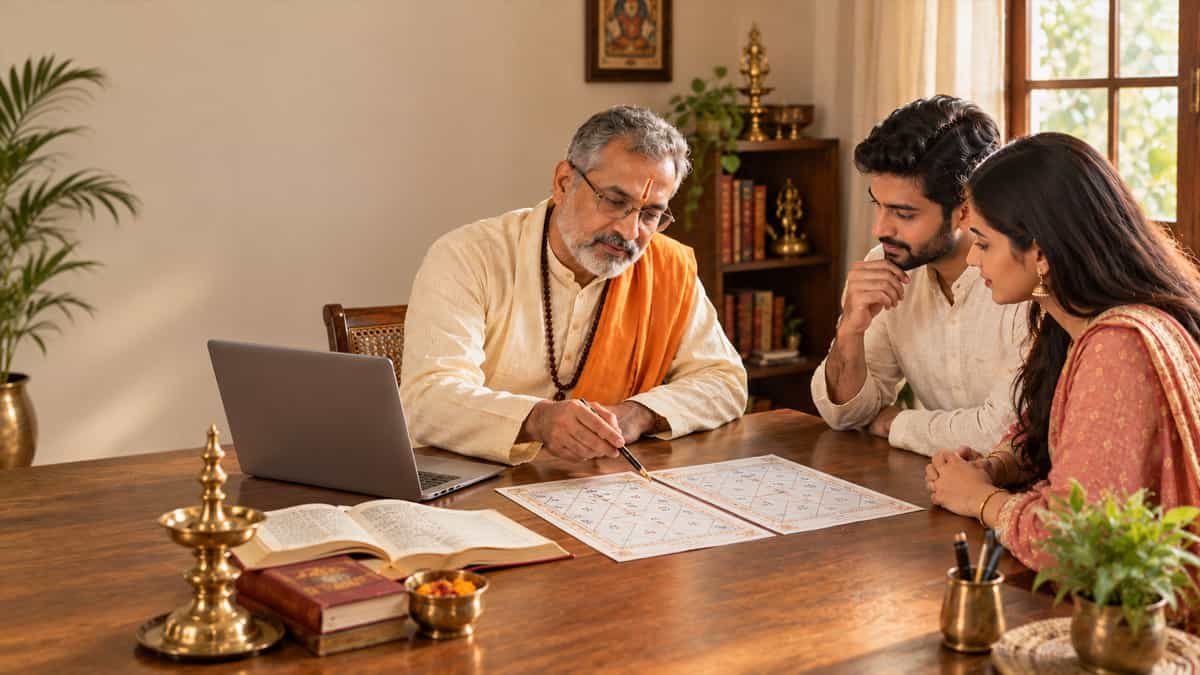
Vedic Partner Matchmaking
Comprehensive Horoscope Compatibility Analysis based on Ascendant (Lagna) & Moon Ashtakoot Guna Milan
Understanding Kundli Matching for Marriage
Kundli matching for marriage is a traditional Vedic astrology practice used to compare two partners’ birth charts. Pushya Astro evaluates the Ascendant (Lagna), Moon-based Ashtakoot Guna Milan and Manglik Dosha as separate aspects of traditional marriage matching.
Whether you are exploring kundli matching online or looking for marriage matching by date of birth, each check offers a different perspective on horoscope compatibility. These preliminary results can help you understand the match before deciding whether a more detailed astrological review is needed.
Why Is Lagna Matching Checked First?
The Lagna, or Ascendant, is the zodiac sign rising on the eastern horizon at the time of birth. In Vedic astrology, it provides the starting point for interpreting an individual’s birth chart.
Comparing both partners’ Lagnas offers an initial perspective on their chart structures. However, the same Lagna does not automatically mean two people are compatible, and different Lagnas do not automatically indicate a poor match.
Accurate birth details matter: an incorrect birth time or birthplace can affect the Ascendant calculation and the resulting interpretation. For this reason, traditional birth-chart matching generally requires the date, time and place of birth.
How Does Ashtakoot Guna Milan Work?
Ashtakoot Guna Milan is a traditional Vedic method of kundli matching based primarily on both partners’ Moon signs (Rashi) and birth Nakshatras.
It evaluates eight factors, known as kootas, with a maximum combined score of 36 points. These factors cover traditional considerations associated with temperament, understanding and other aspects of a partnership.
A higher score indicates a stronger match according to this particular scoring system, but the total alone cannot establish whether a relationship will succeed. A lower score should not automatically be treated as a reason to reject a potential partner.
What Should You Know About Manglik Dosha?
Manglik Dosha is assessed separately from the 36-point Ashtakoot score. In traditional Jyotish, it is associated with the placement of Mars in specified houses of the birth chart.
Its interpretation may vary between astrological traditions and can depend on additional chart factors. Therefore, a Manglik indication should not be treated as a final verdict on a marriage.
Consider it alongside the other kundli matching results rather than allowing one indicator to determine the entire decision. If the results show a significant concern or remain unclear, consult a qualified Vedic astrologer for a more detailed assessment.
How Should You Interpret Your Marriage Matching Results?
- Ascendant Match: An initial comparison of both partners’ Lagnas.
- Ashtakoot Score: A Moon-based compatibility score out of 36.
- Manglik Dosha: A separate traditional consideration that may require further interpretation.
- Matching Recommendation: A summary based on the results available from this tool, not a guarantee of relationship success or failure.
If the preliminary marriage matching results appear favourable and you wish to proceed, consider consulting an experienced Vedic astrologer for a detailed review of the Navamsa (D9) and Saptamsa (D7) charts, where relevant to the astrologer’s assessment.
If the results raise concerns, a detailed review may help you understand their traditional astrological interpretation before making a decision.
Use these findings as a starting point for understanding the match—not as a substitute for your own judgement, communication and consideration of the relationship.
FAQs
Is Kundli Matching Necessary for Marriage?
Kundli matching is a traditional practice followed by many people considering marriage. It can provide an astrological perspective on compatibility, but the decision to marry should also consider mutual understanding, values, communication and personal circumstances.
Can I Do Kundali Matching by Name and Date of Birth?
Kundali matching by name and date of birth is a common search phrase for online marriage compatibility checks. However, name-based matching and detailed birth-chart matching are not necessarily the same method. Traditional birth-chart calculations generally require the date, time and place of birth. Always check which details a particular tool requires.
Is Marriage Matching by Date of Birth Accurate?
Marriage matching by date of birth depends on the method used and the information available. A date alone may not provide enough information for detailed birth-chart calculations, which can also require the exact birth time and birthplace. Astrological interpretations are traditional beliefs, not scientifically established predictions of relationship outcomes.
Is a High Guna Milan Score Enough for Marriage?
Not necessarily. The Ashtakoot score is one traditional compatibility measure. It should not be treated as the sole basis for deciding whether to marry.
Can a Manglik and Non-Manglik Partner Marry?
A Manglik indication does not automatically mean that a match should be rejected. Traditional interpretations differ, and a qualified Vedic astrologer may review the complete birth charts before offering an interpretation.
Does the Same Lagna Mean a Perfect Match?
No. The same Ascendant is only one point of comparison. It does not guarantee compatibility, just as different Ascendants do not automatically indicate incompatibility.
What Is the Difference Between Kundli Matching and Marriage Matching?
Kundli matching usually refers to comparing birth charts according to traditional astrological methods. Marriage matching is a broader term that can include Kundli matching, Guna Milan, Manglik Dosha assessment and other compatibility considerations. The precise meaning depends on the tool or service being used.