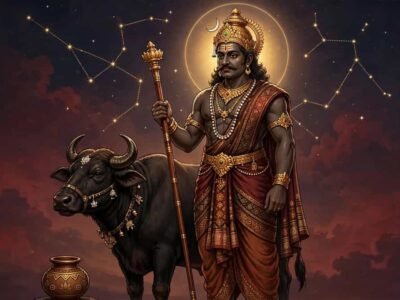
Mula Nakshatra, also commonly spelled Moola Nakshatra, is the 19th of the 27 Nakshatras in Vedic astrology. It occupies 0°00′ to 13°20′ of sidereal Sagittarius (Dhanu Rashi). Its ruling planet in the Vimshottari Dasha system is Ketu, its presiding deity is Nirriti, and its principal symbol is a tied bundle of roots.
The Sanskrit word mūla means “root” or “foundation.” In traditional Jyotish symbolism, Mula is associated with investigation, uncovering what lies beneath the surface, tracing problems to their source, and removing what no longer supports growth. The same symbolism may also involve endings or difficult change, depending on the wider chart and the interpretive tradition.
People whose Moon is placed in Mula are sometimes described in astrology as curious, independent and interested in fundamental questions. These are traditional interpretations, not fixed facts about every person. A complete chart, personal circumstances and individual choices matter far more than one Nakshatra considered alone.
KEY POINTS
- Mula (also spelled Moola) is the 19th Nakshatra, covering 0°00′–13°20′ Sagittarius.
- Ketu is the Nakshatra lord; Jupiter rules Sagittarius, the sign in which all four padas fall.
- The presiding deity is Nirriti, and the main symbol is a tied bundle of roots.
- Traditional themes include inquiry, roots, uncovering causes, release and renewal.
Key Facts About Mula (Moola) Nakshatra
| Attribute | Details |
|---|---|
| Nakshatra number | 19th of the 27 Nakshatras |
| Sanskrit name | Mūla (मूल); also written Mula or Moola |
| Zodiac sign | Sagittarius (Dhanu Rashi) |
| Zodiac range | 0°00′–13°20′ Sagittarius |
| Nakshatra lord | Ketu (Vimshottari Dasha lord) |
| Sagittarius sign lord | Jupiter (Guru) |
| Presiding deity | Nirriti (also transliterated Nirrti) |
| Main symbol | A tied bundle of roots |
| Gana | Rakshasa Gana, a traditional Jyotish category |
| Yoni | Dog, in traditional compatibility classifications |
| Nadi | Adi Nadi |
| Pada 1 syllable | Ye (ये) |
| Pada 2 syllable | Yo (यो) |
| Pada 3 syllable | Bha (भा) |
| Pada 4 syllable | Bhi (भी) |
| Navamsa signs | Aries, Taurus, Gemini and Cancer |
| Traditional Muhurta category | Tikshna (sharp), in common electional classifications |
| Traditional themes | Roots, inquiry, foundations, release and transformation |
Gana, yoni, nadi and Muhurta categories belong to traditional astrological systems. They are not scientific measurements of personality, health, compatibility or destiny. Some details and transliterations vary between lineages.
What Does Mula or Moola Nakshatra Mean?
The Sanskrit word mūla means root, base or foundation. Roots are usually hidden from view, but they support a plant, take in nourishment and help determine how it grows. This makes the root an apt symbol for looking beyond surface appearances and asking what is really sustaining a situation.
In a symbolic reading, Mula can represent the urge to trace an outcome back to its original cause. This may appear as research, questioning assumptions, investigating a complicated issue or wanting to understand why a system works as it does. It can also suggest a willingness to let go of an old structure after discovering that its foundations are no longer sound.
The image of roots being gathered or pulled up has two sides. Roots can reveal a source of strength, but uprooting can also disturb what was established. For that reason, traditional Mula interpretations often pair direct inquiry with the need for care, patience and a clear reason before making irreversible changes.
CORE THEMES OF MULA NAKSHATRA
- ✓ Getting to the root: Looking for underlying causes rather than stopping at surface explanations.
- ✓ Research and inquiry: Exploring difficult questions, evidence, origins and hidden connections.
- ✓ Release and renewal: Reviewing what has outlived its purpose and deciding what should change.
- ✓ Truth with discernment: Being direct while remembering that a strong conclusion still needs evidence and context.
The Symbol of Mula Nakshatra: A Bundle of Roots
Mula’s most widely used symbol is a bundle of roots tied together. It points toward origins, hidden support systems, ancestry and the parts of a matter that may not be visible at first glance. Unlike symbols that emphasise outward appearance, roots direct attention to what lies beneath the surface.
A bundle also brings separate strands together. Symbolically, this can represent gathering evidence, tracing several events back to a common source or connecting details that initially appear unrelated. It may also reflect the effort required to untangle a complicated situation before deciding what to preserve and what to remove.
The symbol should not be read as a prediction that a person will experience loss or upheaval. Traditional symbolism offers a way of interpreting themes; it does not determine what must happen in an individual life.
The practical lesson associated with the roots is to investigate before uprooting. A rushed decision may remove something valuable along with the problem. Careful examination helps distinguish what needs repair, what needs to be released and what deserves to remain.
Who Is Nirriti, the Presiding Deity of Mula Nakshatra?
Nirriti (also written Nirrti) is the presiding deity traditionally associated with Mula Nakshatra. In Vedic and later Hindu traditions, Nirriti is connected with dissolution, decline, misfortune or the realm beyond established order; descriptions vary across texts and interpretations. This association is one reason Mula is sometimes discussed through themes of endings, vulnerability and the removal of what has become unstable.
These mythological associations should be approached within their religious and literary context. They do not mean that a person born under Mula is harmful, unlucky or destined to bring misfortune to family members. Such conclusions are not justified by a Nakshatra alone and can cause needless fear.
In symbolic interpretation, Nirriti may prompt reflection on what happens when a structure weakens, a truth can no longer be ignored or an old arrangement reaches its limit. The emphasis can be on recognising impermanence and responding thoughtfully, rather than assuming that every change is negative.
SYMBOLIC EXPRESSIONS ASSOCIATED WITH MULA
- ✓ Facing difficult truths: Being willing to examine an uncomfortable issue instead of avoiding it.
- ✓ Questioning foundations: Checking whether a belief, plan or system rests on reliable assumptions.
- ✓ Recognising endings: Understanding when a stage has reached its natural limit and needs to be reconsidered.
- ✓ Learning through discernment: Separating fear-based interpretations from careful, practical decisions.
These are interpretive themes in Jyotish, not guaranteed qualities of everyone whose chart contains Mula Nakshatra.
Ketu: The Ruling Planet of Mula Nakshatra
Ketu is the ruler of Mula Nakshatra in the Vimshottari Dasha system. Mula lies entirely within Sagittarius, whose sign ruler is Jupiter. These are different astrological roles: Ketu is the Nakshatra lord, while Jupiter is the ruler of the zodiac sign occupied by all four padas.
In traditional astrology, Ketu is associated with detachment, inward investigation, nonconformity, spiritual inquiry and experiences that loosen attachment to familiar identities. Mula’s root symbolism is often interpreted through these themes: searching beneath appearances and separating a core truth from assumptions or habits.
Jupiter, the sign lord of Sagittarius, is associated with learning, philosophy, ethics, teaching and the search for broader meaning. In a combined interpretation, Ketu’s investigative symbolism and Jupiter’s philosophical orientation can make Mula a useful subject for discussing research, questioning, study and the reassessment of beliefs.
The same symbolism has potential challenges. Skepticism can become excessive suspicion, directness can become harshness, and the desire to remove a problem can lead to abandoning something before its value is understood. Patience, proportion and evidence provide a practical counterbalance.
The expression attributed to Ketu and Jupiter varies according to their actual placements, aspects, dignity, house relationships and planetary periods in the full chart. A Nakshatra description cannot replace a complete chart analysis or determine life outcomes by itself.
Mula Nakshatra Personality Traits
Mula is traditionally linked with curiosity, investigation, independence and a desire to understand fundamental causes. In a symbolic reading, a person with a prominent Mula placement may be described as someone who asks questions, looks beneath appearances and prefers a meaningful explanation over a superficial answer.
Some interpretations emphasise courage in confronting complicated subjects or willingness to reconsider an old point of view. Others highlight the challenge of being too blunt, sceptical or quick to remove something that feels unnecessary. Neither set of traits applies automatically to every individual.
The following strengths and challenges are conventional astrological descriptions intended for general understanding—not a psychological assessment, diagnosis or guarantee about anyone born under Mula.
STRENGTHS
- ✓ Strong curiosity and investigative thinking
- ✓ Interest in underlying causes
- ✓ Independence of thought
- ✓ Courage to question assumptions
- ✓ Research-oriented approach
- ✓ Ability to notice inconsistencies
- ✓ Openness to deeper study
- ✓ Resilience during change
- ✓ Direct communication
- ✓ Willingness to revise beliefs
- ✓ Philosophical or spiritual curiosity
- ✓ Resourcefulness when solving complex problems
- ✓ Focus on essentials
- ✓ Capacity to let go of outdated methods
- ✓ Persistence in seeking answers
- ✓ Interest in history, roots and origins
- ✓ Ability to work through uncertainty
- ✓ Preference for meaningful goals
- ✓ Potential for strategic analysis
- ✓ Readiness to rebuild after a setback
POTENTIAL CHALLENGES
- ✕ Over-questioning or excessive scepticism
- ✕ Blunt words that may hurt others
- ✕ Impatience with incomplete answers
- ✕ Difficulty accepting uncertainty
- ✕ Tendency to uproot plans too quickly
- ✕ All-or-nothing thinking
- ✕ Restlessness when progress is slow
- ✕ Distrust without enough evidence
- ✕ Over-focusing on problems
- ✕ Difficulty maintaining routine after initial interest
- ✕ Resisting advice too quickly
- ✕ Emotional distance during difficult discussions
- ✕ Taking a strong position before checking all facts
The Four Padas of Mula Nakshatra
Mula Nakshatra is divided into four padas, or quarters. Each pada covers 3°20′ and occupies a different Navamsa sign. All four padas remain within Sagittarius in the main sidereal zodiac, but their Navamsa signs differ and are traditionally used to add another layer of interpretation.
The commonly used naming syllables are Ye, Yo, Bha and Bhi. Transliteration and pronunciation can vary by language and regional naming practice. These syllables are traditional naming guidance, not a requirement that every person must follow.
Mula Nakshatra Pada 1
Degree range: 0°00′–3°20′ Sagittarius
Navamsa sign: Aries
Navamsa ruler: Mars
Traditional naming syllable: Ye (ये)
Purushartha association: Dharma
The first pada falls in Aries Navamsa, traditionally ruled by Mars. This combination is often interpreted as giving Mula’s investigative impulse an active, decisive or pioneering expression. It may symbolise a preference for addressing a question directly and taking the first step toward a solution.
A useful balance is to pair courage with preparation. Moving quickly can be helpful when the facts are clear, but a fast reaction may cause unnecessary disruption when more context is needed. Listening and checking assumptions can make directness more constructive.
Mula Nakshatra Pada 2
Degree range: 3°20′–6°40′ Sagittarius
Navamsa sign: Taurus
Navamsa ruler: Venus
Traditional naming syllable: Yo (यो)
Purushartha association: Artha
The second pada falls in Taurus Navamsa, ruled by Venus. Taurus is traditionally associated with stability, material resources, consistency and tangible results. This pada is often read as giving Mula’s search for foundations a practical focus: understanding what makes a plan sustainable and which resources it needs to succeed.
Its challenge may be a tension between wanting to remove what seems unnecessary and wanting to retain security or familiar comforts. Thoughtful evaluation can help distinguish a stable foundation from a habit that merely feels comfortable.
Mula Nakshatra Pada 3
Degree range: 6°40′–10°00′ Sagittarius
Navamsa sign: Gemini
Navamsa ruler: Mercury
Traditional naming syllable: Bha (भा)
Purushartha association: Kama
The third pada falls in Gemini Navamsa, ruled by Mercury. Gemini is associated in Jyotish with communication, information, curiosity and the exchange of ideas. Traditional interpretations may therefore place greater emphasis on questioning, comparing sources, explaining findings or following several lines of inquiry.
The potential difficulty is scattered attention. Research can expand indefinitely when every new question opens another path. Defining the central question, documenting evidence and deciding when there is enough information can help complete the work.
Mula Nakshatra Pada 4
Degree range: 10°00′–13°20′ Sagittarius
Navamsa sign: Cancer
Navamsa ruler: Moon
Traditional naming syllable: Bhi (भी)
Purushartha association: Moksha
The fourth pada falls in Cancer Navamsa, ruled by the Moon. Cancer is traditionally associated with emotional life, home, memory, care and belonging. In this interpretive framework, Mula’s themes of origins and roots can connect with family history, inherited beliefs and the emotional foundations of identity.
Its challenge may be revisiting old material so intensely that it becomes difficult to move forward, or making an abrupt change in response to a strong feeling. Emotional awareness, supportive conversations and time for reflection can help place difficult discoveries in a wider context.
Mula Padas at a Glance
| Pada | Navamsa | Ruler | Syllable | Traditional emphasis |
|---|---|---|---|---|
| 1 | Aries | Mars | Ye | Initiative and direct investigation |
| 2 | Taurus | Venus | Yo | Stability and practical foundations |
| 3 | Gemini | Mercury | Bha | Inquiry and communication |
| 4 | Cancer | Moon | Bhi | Roots, memory and emotional understanding |
The Purushartha associations—Dharma, Artha, Kama and Moksha—are commonly mapped in this order across the four pada Navamsa sequence. These are traditional interpretive associations, and individual schools may emphasise them differently.
POSITIVE TRAITS TRADITIONALLY ASSOCIATED WITH MULA
- ✓ 1. Investigative curiosity: A desire to understand how and why something works.
- ✓ 2. Root-cause thinking: Looking for the source of a problem rather than only its symptoms.
- ✓ 3. Independence: A preference for forming considered conclusions rather than copying a view unquestioningly.
- ✓ 4. Courage to question: Readiness to review familiar beliefs and assumptions.
- ✓ 5. Research orientation: Interest in gathering details and comparing explanations.
- ✓ 6. Intellectual honesty: Willingness to change an opinion when evidence points elsewhere.
- ✓ 7. Focus on essentials: Ability to ask which parts of a plan are truly necessary.
- ✓ 8. Persistence: Continuing to investigate a problem after the easy answers fail.
- ✓ 9. Directness: A preference for clear and unambiguous communication.
- ✓ 10. Resourcefulness: Searching for alternative routes when a method stops working.
- ✓ 11. Resilience: Finding ways to rebuild after an unexpected change.
- ✓ 12. Openness to deeper learning: Interest in philosophy, history, research or spiritual questions.
- ✓ 13. Analytical perspective: Noticing patterns and inconsistencies in complex information.
- ✓ 14. Adaptability: Revising a plan when its foundation proves weak.
- ✓ 15. Determination: Staying engaged with a question that has real meaning.
- ✓ 16. Willingness to simplify: Removing unnecessary complexity from a process.
- ✓ 17. Reflective thinking: Considering origins, motives and long-term implications.
- ✓ 18. Practical problem-solving: Turning an investigation into a clear next step.
- ✓ 19. Capacity for renewal: Recognising that an ending can create space for a better approach.
- ✓ 20. Commitment to truth-seeking: Preferring an honest answer to a convenient but unsupported one.
POTENTIAL CHALLENGES OF MULA NAKSHATRA
- ✓ 1. Excessive scepticism: Questioning a claim even when enough reliable evidence is available.
- ✓ 2. Impatience: Wanting a root cause or final answer before the facts are clear.
- ✓ 3. Harsh directness: Sharing a valid observation in a way that feels unnecessarily sharp.
- ✓ 4. All-or-nothing thinking: Treating a complicated situation as if it has only two possible answers.
- ✓ 5. Over-investigation: Continuing to search long after the decision-relevant facts are established.
- ✓ 6. Abrupt change: Discarding a plan before considering whether a repair would be enough.
- ✓ 7. Distrust: Assuming hidden motives without adequate evidence.
- ✓ 8. Restlessness: Becoming uncomfortable with gradual progress or repetitive work.
- ✓ 9. Fixation on problems: Focusing on what is broken rather than recognising what still works.
- ✓ 10. Difficulty with routine: Losing interest in the steady work needed after discovery.
- ✓ 11. Resistance to advice: Rejecting another perspective before examining its merits.
- ✓ 12. Emotional withdrawal: Going quiet during difficult conversations instead of explaining what is happening.
- ✓ 13. Premature certainty: Reaching a strong conclusion before reviewing all sides of an issue.
These lists describe possible expressions of a traditional symbol system. They are not a checklist for judging a person, and no trait is guaranteed by the Moon’s Nakshatra alone.
Mula Nakshatra Career and Professional Life
Traditional career interpretations of Mula often highlight research, diagnosis, investigation, analysis and work that involves tracing a problem to its source. The roots symbol may also be used to describe roles that examine origins, foundations, evidence or systems that need to be rebuilt.
CAREER DOMAINS SOMETIMES ASSOCIATED WITH MULA
- ✓ Research and analysis: Academic research, data analysis, market research and investigative work.
- ✓ Technology and troubleshooting: Debugging, systems analysis, cybersecurity analysis and root-cause investigations.
- ✓ Healthcare and diagnostics: Roles involving careful assessment and the investigation of underlying causes, with appropriate professional training.
- ✓ Law and compliance: Reviewing evidence, auditing processes, fact-finding and checking whether rules have been followed.
- ✓ Writing and teaching: Explaining complex subjects, researching origins and presenting findings clearly.
- ✓ Psychology and social research: Studying patterns and context within the scope of appropriate qualifications.
- ✓ History and archival work: Exploring ancestry, records, languages and the origins of ideas.
- ✓ Repair and process improvement: Finding why a process fails and making evidence-based improvements.
These are symbolic associations, not career predictions. Education, practical skills, interests, opportunity and work experience are more useful guides for real career choices than a Nakshatra by itself.
Mula Nakshatra in Love and Relationships
In traditional interpretations, Mula’s preference for depth and direct questions can be associated with relationships that value honesty and a willingness to discuss difficult subjects. The roots symbol may also invite reflection on family patterns, personal history and the assumptions people bring into a partnership.
A constructive expression of this theme is to ask clear questions without treating every uncertainty as evidence of a hidden problem. Honest discussion works best when both people have room to explain their perspective and when concerns are checked rather than automatically assumed to be true.
Potential challenges described in astrology include blunt communication, a strong need to resolve uncertainty quickly or an urge to make a decisive break during a difficult moment. Taking time to understand the issue, expressing needs calmly and avoiding irreversible choices in the heat of an argument can help any relationship.
RELATIONSHIP TIPS FOR MULA
- Ask questions to understand, not simply to challenge.
- Distinguish a genuine concern from an assumption that has not been checked.
- Make major decisions after emotions have settled and the relevant facts are clear.
- Discuss personal boundaries, family expectations and long-term plans openly.
- Use direct language with respect, and give the other person time to respond.
Mula Nakshatra and Family Life
Mula’s roots symbolism can be used in traditional readings to discuss ancestry, family history, inherited expectations and the foundations on which a household operates. Some interpretations describe a person who wants to understand family patterns and decide which customs remain helpful in the present.
This does not mean that Mula causes family conflict or loss. Family relationships are shaped by many real-world factors, including communication, health, resources, circumstances and the choices of everyone involved. A Nakshatra cannot establish that a child will harm relatives or bring misfortune to a household.
A practical way to use the symbol is to examine inherited habits with care: keep what provides support, discuss what causes difficulty, and change old patterns without blaming an individual for events outside their control.
Mula Nakshatra, Gandamool and Gandanta
Mula is traditionally counted among the six Gandamool Nakshatras, along with Ashwini, Ashlesha, Magha, Jyeshtha and Revati. In some Hindu astrological traditions, families consult a priest or astrologer about a Shanti ritual after the birth of a child in one of these Nakshatras. The timing and procedures differ by family tradition and regional practice.
Gandanta is a related but more specific concept associated with junctions between water signs and fire signs. Mula begins at 0°00′ Sagittarius, directly after Scorpio, and its first pada (0°00′–3°20′ Sagittarius) is commonly associated with the Sagittarius-side Gandanta zone. This does not mean that the whole of Mula is Gandanta.
Some traditional beliefs attach strong significance to these classifications, but they should not be used to frighten parents or make claims that a child will cause harm to a mother, father or other relative. There is no scientific evidence that a Nakshatra determines such outcomes. A birth chart cannot replace medical guidance, family support or a child’s individual development.
If a family chooses to observe a traditional ritual, it may be approached as a religious or cultural practice. Procedures and recommended dates vary, so families can consult a trusted, non-alarmist practitioner within their own tradition. Avoid anyone who uses fear to pressure a family into expensive or coercive remedies.
Mula Nakshatra and Traditional Muhurta
In common electional astrology classifications, Mula is described as a Tikshna or sharp Nakshatra. Traditional texts associate this category with particular kinds of forceful, separating, investigative or difficult actions. The exact activities considered suitable differ among Muhurta manuals, Panchangs and lineages.
Tikshna is a technical classification used to describe a traditional electional category. It is not a moral judgement about people born under Mula and does not mean that every day when the Moon transits Mula is automatically bad. Choosing a time for an important event generally depends on the broader Panchang and the rules followed by the person making the election.
How to Interpret Mula Nakshatra in a Birth Chart
A balanced Jyotish interpretation starts by identifying which planet occupies Mula. The Moon’s Nakshatra is especially important in many Vedic astrology traditions because it identifies the Janma Nakshatra and helps determine the starting point of the Vimshottari Dasha sequence.
Next, consider the pada. Mula’s four padas occupy Aries, Taurus, Gemini and Cancer Navamsas, respectively. Traditional astrologers may use these distinctions to refine the symbolic reading, but the pada alone cannot determine a person’s character, relationships or results.
The next step is to examine the house placement, planetary condition, aspects, dispositors and relevant Dasha periods. Since Mula lies entirely in Sagittarius, Jupiter is the sign lord and Ketu is the Nakshatra lord. Their placements and relationships in the chart can change how a traditional astrologer interprets Mula’s themes.
Finally, keep the interpretation in perspective. Astrology is a cultural and spiritual tradition, not a scientifically established way to predict an individual’s personality or future. Use its symbolism for reflection if it is meaningful to you, not as a substitute for evidence, personal agency or qualified professional advice.
FAQs
What is Mula or Moola Nakshatra?
Mula, also spelled Moola, is the 19th Nakshatra in Vedic astrology. It spans 0°00′ to 13°20′ of sidereal Sagittarius and is symbolised by a tied bundle of roots.
Which planet rules Mula Nakshatra?
Ketu is the Nakshatra lord in the Vimshottari Dasha system. Sagittarius, the sign containing all four padas of Mula, is ruled by Jupiter.
Who is the deity of Mula Nakshatra?
The presiding deity is Nirriti, also written Nirrti. Traditional descriptions associate Nirriti with dissolution and decline, although interpretations vary across texts and lineages.
What is the symbol of Mula Nakshatra?
The principal symbol is a tied bundle of roots. It is traditionally linked with origins, foundations, investigation and the act of uncovering what lies beneath the surface.
What are the four padas of Mula Nakshatra?
Pada 1 is Aries Navamsa with Ye; Pada 2 is Taurus Navamsa with Yo; Pada 3 is Gemini Navamsa with Bha; and Pada 4 is Cancer Navamsa with Bhi. Each pada covers 3°20′ of Sagittarius.
Is Mula Nakshatra considered Gandamool?
Yes. Mula is traditionally one of the six Gandamool Nakshatras. Gandanta is a more specific junction concept; the beginning of Sagittarius, including Mula’s first pada in common classifications, is the relevant zone.
Does Mula Nakshatra bring misfortune to the family?
A Nakshatra alone cannot establish that a child will bring misfortune or harm to relatives. Such claims are traditional beliefs rather than scientifically established facts and should not be used to stigmatise a child or frighten a family.
What is the Gana, Yoni and Nadi of Mula?
Common Jyotish classifications list Mula as Rakshasa Gana, Dog Yoni and Adi Nadi. These labels belong to traditional compatibility systems and are not scientific descriptions of a person.
What is the traditional Muhurta nature of Mula?
Mula is commonly classified as Tikshna, or sharp, in electional astrology. The category describes traditional rules for selecting times for certain activities; it is not a judgement about a person born under Mula.
What are the naming syllables for Mula Nakshatra?
The commonly used syllables are Ye (ये), Yo (यो), Bha (भा) and Bhi (भी), corresponding to the four padas. Transliteration can vary by language and regional custom.
Is Mula Nakshatra good or bad?
Traditional Jyotish does not need to be reduced to a simple good-or-bad label. Mula has several symbolic interpretations, and a complete chart and real-life context are considered in traditional readings. Astrology is not a scientifically verified method of predicting outcomes.
Mula Nakshatra begins the Sagittarius section of the traditional 27-Nakshatra sequence and carries symbolism around roots, origins, inquiry and transformation. Its tied-roots emblem encourages readers to look beyond appearances and understand what supports a situation before deciding how to change it.
Its four padas add traditional layers through Aries, Taurus, Gemini and Cancer Navamsas. Ketu is the Nakshatra lord, Jupiter is the Sagittarius sign lord, and Nirriti is the presiding deity. These are distinct roles within the astrological framework and should not be confused.
A balanced approach to Mula symbolism is to combine curiosity with patience, directness with compassion, and the desire for change with careful judgement. Discovering a root cause can be valuable, but sound decisions still depend on evidence, circumstances and follow-through.
Disclaimer: This article explains traditional Vedic astrological concepts for educational and cultural purposes. Personality descriptions, Muhurta categories and astrological predictions are not scientifically established facts and should not be treated as definitive assessments of a person or their future. No Nakshatra alone establishes that a child will bring harm or misfortune to family members.