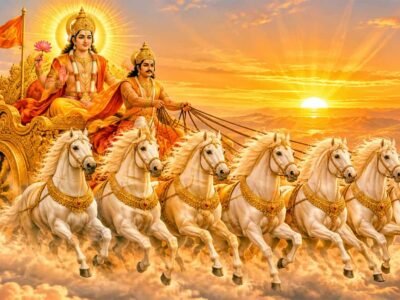
Hasta Nakshatra is the thirteenth of the 27 Nakshatras in Vedic astrology. It occupies the span from 10°00′ to 23°20′ of sidereal Virgo (Kanya Rashi). Its ruling planet in the Vimshottari Dasha system is the Moon, its presiding deity is Savitar, and its principal symbol is an open hand or palm.
In traditional Jyotish, Hasta is associated with skill, dexterity, practical intelligence, careful work and the ability to turn an idea into something tangible. The hand symbol connects it with making, shaping, handling, giving and receiving. Savitar, a Vedic solar deity associated with inspiration and the power that sets life in motion, adds a theme of bringing potential into action.
People whose Moon is placed in Hasta are traditionally described as resourceful, observant and capable with practical details. These are symbolic astrological interpretations, not a reliable personality test. A full reading considers the entire birth chart, including planetary placements, houses, aspects, planetary periods and real-life circumstances.
KEY POINTS
- Hasta is the 13th of the 27 Nakshatras and spans 10°00′–23°20′ Virgo.
- Its Vimshottari Dasha lord is the Moon; Mercury rules Virgo, the zodiac sign containing all four padas.
- The presiding deity is Savitar, and the main symbol is an open hand or palm.
- Traditional themes include dexterity, practical skill, resourcefulness, service and bringing ideas into action.
Key Facts About Hasta Nakshatra
| Attribute | Details |
|---|---|
| Nakshatra number | 13th of the 27 Nakshatras |
| Sanskrit name | Hasta (हस्त) |
| Meaning of the name | Hand or palm |
| Zodiac sign | Virgo (Kanya Rashi) |
| Zodiac range | 10°00′–23°20′ sidereal Virgo |
| Nakshatra lord | Moon (Chandra) |
| Virgo sign lord | Mercury (Budha) |
| Presiding deity | Savitar (Savitr), a Vedic solar deity |
| Main symbol | Open hand or palm; sometimes represented as a fist |
| Gana | Deva Gana |
| Yoni | Buffalo, traditionally classified as female in some Jyotish tables |
| Nadi | Adi Nadi |
| Pada 1 syllable | Pu (पू) |
| Pada 2 syllable | Sha (ष) |
| Pada 3 syllable | Na (ण) |
| Pada 4 syllable | Tha (ठ) |
| Navamsa signs | Aries, Taurus, Gemini and Cancer |
| Traditional Muhurta nature | Kshipra or Laghu (swift/light) |
| Traditional themes | Craft, dexterity, practical skill, service and manifestation |
Gana, yoni and nadi are traditional classifications used in Jyotish, especially in compatibility methods. They are part of an astrological framework and should not be treated as scientific descriptions of an individual.
What Does Hasta Nakshatra Mean?
The Sanskrit word hasta means “hand.” A hand can hold, make, write, repair, shape, protect, offer help and accept something from another person. These everyday actions form the foundation of Hasta’s symbolism in Vedic astrology.
Hasta falls entirely within Virgo, a sign traditionally associated with analysis, organisation, service and attention to detail. In this symbolic combination, the hand represents the practical side of intelligence: not only understanding how something works, but also knowing how to handle it, improve it or create a useful result.
Traditional interpretations often group Hasta’s symbolism into three broad themes:
CORE THEMES OF HASTA
- ✓ Skill and dexterity: Working carefully with the hands, tools, language, numbers or detailed processes.
- ✓ Practical intelligence: Finding workable methods, noticing details and turning ideas into useful outcomes.
- ✓ Helpful action: Using knowledge and ability to support others, solve problems or make daily tasks easier.
The hand also has a two-way meaning: it can give and it can receive. Hasta’s symbolism can therefore include generosity, exchange, negotiation and the ability to work effectively with other people. In practice, a skill becomes most useful when it is paired with good judgement, reliability and respect for others.
The Symbol of Hasta Nakshatra: The Open Hand
The open hand or palm is the principal symbol of Hasta Nakshatra. It can represent dexterity, action, craftsmanship and the capacity to shape something through effort. A hand is a tool, but it is also a means of communication: a gesture can welcome, guide, reassure, warn or express an idea without words.
In traditional interpretation, this symbol connects Hasta with activities that require steady hands, attention and practice. These may include writing, drawing, cooking, repairing, designing, crafting, surgery, technical work, teaching a skill or organising information. The point is not that every Hasta placement produces a particular talent, but that skill and practical application are central to the Nakshatra’s symbolism.
The open palm can also suggest transparency and giving. Yet hands can grasp too tightly as well as help. A balanced reading of the symbol includes the difference between using skill responsibly and trying to control every detail or outcome.
For this reason, Hasta’s traditional themes include both capability and restraint. Practice can improve skill, but patience, ethical judgement and a willingness to learn from mistakes are important parts of using that skill well.
Who Is Savitar, the Deity of Hasta Nakshatra?
Savitar (also written Savitr) is a Vedic solar deity associated with vivifying energy, inspiration and the force that prompts living beings into activity. He is related to the Sun, though the Vedic names and functions associated with solar divinity are not always interchangeable in every passage or tradition.
Savitar’s association with Hasta contributes a theme of setting something in motion and helping potential become action. If the hand symbol represents practical ability, Savitar can be understood as the inspiration or animating power behind that ability. The traditional image is of skill guided by purpose rather than action for its own sake.
SYMBOLIC EXPRESSIONS OF SAVITAR
- ✓ Inspiration to begin a task or put an idea into practice.
- ✓ The ability to bring order and direction to practical activity.
- ✓ Using knowledge and skill to create, repair or improve something.
- ✓ Supporting useful work through discipline, clarity and purposeful effort.
- ✓ Recognising that ability becomes more valuable when used responsibly.
These are symbolic associations within Vedic tradition. They do not guarantee a person’s talents, profession, temperament or life events. Religious accounts and interpretations of Savitar can also differ across texts and traditions.
The Moon: Ruling Planet of Hasta Nakshatra
The Moon is the ruling planet of Hasta Nakshatra in the Vimshottari Dasha system. All four padas of Hasta fall in Virgo, whose sign ruler is Mercury. These are different astrological roles: the Moon is the Nakshatra lord, while Mercury is the ruler of the zodiac sign occupied by Hasta.
In traditional Jyotish, the Moon is associated with the mind, feelings, habits, responsiveness and the way a person experiences daily life. Mercury is associated with communication, learning, calculation, analysis and the handling of information. Read symbolically together, these themes can describe practical intelligence that responds to people and circumstances while paying attention to details.
This combination is sometimes interpreted as a capacity to notice what needs to be done and then work out a method for doing it. It can be associated with planning, adapting, communicating clearly or learning by practice. However, the actual interpretation depends on the Moon’s condition, Mercury’s placement, the house involved, planetary aspects and the complete birth chart.
The same symbolism can point to challenges when overemphasised. Concern about details can become worry, cleverness can turn into overthinking, and a desire to make things right can become perfectionism. These are possible themes in astrological interpretation, not fixed traits of everyone with a Hasta Moon.
Hasta Nakshatra Personality Traits
Hasta is traditionally associated with an observant, adaptable and practical temperament. Its hand symbol emphasises the ability to work with what is available, learn through practice and respond to a task with skill. Virgo’s association with detail and Mercury’s link with analysis add to this imagery.
People with an important Hasta placement may be described in Jyotish as good at noticing small details, learning procedures, finding efficient methods or helping others through practical action. They may prefer a problem that can be worked on step by step rather than an abstract discussion with no clear next move.
These descriptions are conventional astrological interpretations, not a verified personality assessment. Individuals vary widely, and no single Nakshatra can establish what someone is like.
STRENGTHS
- ✓ Practical skill and dexterity
- ✓ Attention to detail
- ✓ Resourceful problem-solving
- ✓ Quick learning through practice
- ✓ Adaptability in changing situations
- ✓ Clear, useful communication
- ✓ Organising information and tasks
- ✓ Patience with hands-on work
- ✓ A helpful and service-minded outlook
- ✓ Careful observation
- ✓ Ability to improve a process
- ✓ Creativity applied to practical needs
- ✓ Negotiation and exchange skills
- ✓ Responsibility with tools or resources
- ✓ Willingness to refine a skill
- ✓ Calm handling of routine work
- ✓ Good coordination of small tasks
- ✓ Ability to turn ideas into action
- ✓ Thoughtful planning
- ✓ Sensitivity to what others need
POSSIBLE CHALLENGES
- ✕ Overthinking small details
- ✕ Perfectionism that delays completion
- ✕ Worry about making mistakes
- ✕ Excessive focus on fixing others’ problems
- ✕ Restlessness when results are slow
- ✕ Difficulty delegating tasks
- ✕ Trying to control too many variables
- ✕ Being overly critical of self or others
- ✕ Using cleverness to avoid direct conversations
- ✕ Scattering effort across too many small tasks
- ✕ Holding on to methods that once worked
- ✕ Confusing busyness with progress
- ✕ Taking criticism too personally
- ✕ Underestimating the value of rest
The Four Padas of Hasta Nakshatra
Hasta Nakshatra is divided into four padas, or quarters. Each pada covers 3°20′ of the zodiac. All four padas remain in Virgo in the main Rashi chart, but each occupies a different Navamsa sign: Aries, Taurus, Gemini and Cancer, in that order.
In traditional interpretation, the Navamsa sign and its ruler provide an additional layer for discussing each pada. The naming syllables commonly assigned to the four padas are Pu, Sha, Na and Tha. Sanskrit sounds may be transliterated differently between regional traditions, so spellings can vary slightly.
Hasta Nakshatra Pada 1
Degree range: 10°00′–13°20′ Virgo
Navamsa sign: Aries
Navamsa ruler: Mars
Traditional naming syllable: Pu (पू)
Purushartha association: Dharma
The first pada falls in Aries Navamsa, ruled by Mars. Aries is traditionally associated with initiative, courage and beginning action. In the context of Hasta, this can be interpreted as skill expressed through energetic effort: learning by doing, taking responsibility for a task or being willing to start a practical project.
Its symbolic strength is the readiness to act rather than remain stuck in indecision. The possible challenge is impatience. When a person wants immediate results, careful practice and checking work can feel frustrating even though these steps are essential to developing real skill.
A balanced interpretation combines initiative with preparation. Starting quickly is useful when paired with attention to safety, planning and completing the work properly.
Hasta Nakshatra Pada 2
Degree range: 13°20′–16°40′ Virgo
Navamsa sign: Taurus
Navamsa ruler: Venus
Traditional naming syllable: Sha (ष)
Purushartha association: Artha
The second pada falls in Taurus Navamsa, ruled by Venus. Taurus is associated in traditional astrology with stability, resources, comfort and tangible results. Applied to Hasta, the symbolism may emphasise careful craftsmanship, consistency and the wish to make something useful, durable or pleasing to the senses.
This pada can be interpreted as favouring steady improvement over rushed results. It may symbolise an interest in quality, materials, design or practical work that produces visible value. Its challenge can be becoming attached to familiar methods, comfort or an overly narrow idea of what counts as good work.
Its practical lesson is to combine consistency with openness to feedback. Quality can be built through repetition, but it also requires adjusting a method when better information becomes available.
Hasta Nakshatra Pada 3
Degree range: 16°40′–20°00′ Virgo
Navamsa sign: Gemini
Navamsa ruler: Mercury
Traditional naming syllable: Na (ण)
Purushartha association: Kama
The third pada falls in Gemini Navamsa, also ruled by Mercury. Gemini is traditionally connected with language, curiosity, learning and the exchange of ideas. In this pada, Hasta’s practical skill may be interpreted through communication, writing, teaching, analysis or handling information carefully.
The symbolic strengths include curiosity, quick learning and the ability to explain how a process works. This can be useful in work that requires both precision and communication—for example, documentation, training, editing, research support or technical explanation.
The potential challenge is scattered attention. Too many interests or continual revisions may make it difficult to settle on a decision or finish a task. A useful balance is to give research a clear purpose and set a realistic point at which to complete the work.
Hasta Nakshatra Pada 4
Degree range: 20°00′–23°20′ Virgo
Navamsa sign: Cancer
Navamsa ruler: Moon
Traditional naming syllable: Tha (ठ)
Purushartha association: Moksha
The fourth pada falls in Cancer Navamsa, ruled by the Moon. Cancer is traditionally associated with care, security, emotional understanding and belonging. In Hasta, this can symbolise practical skills used to protect, support or comfort other people.
This pada may be interpreted as having a more nurturing expression of the hand symbol: preparing, organising, repairing or doing small tasks that make life easier for loved ones. It can also point to sensitivity to the atmosphere around a task or to the needs of the people involved.
The possible challenge is taking on too much responsibility for others or reacting emotionally when one’s efforts are not recognised. Helping is more sustainable when it includes boundaries, clear communication and space for others to handle their own responsibilities.
Hasta Padas at a Glance
| Pada | Navamsa | Ruler | Syllable | Traditional emphasis |
|---|---|---|---|---|
| 1 | Aries | Mars | Pu (पू) | Initiative and energetic action |
| 2 | Taurus | Venus | Sha (ष) | Consistency and tangible results |
| 3 | Gemini | Mercury | Na (ण) | Communication and learning |
| 4 | Cancer | Moon | Tha (ठ) | Care and practical support |
The Purushartha associations—Dharma, Artha, Kama and Moksha—are traditional philosophical aims of life that some Jyotish systems map to these pada/Navamsa divisions. They are interpretive categories rather than measurable predictions about a person’s life.
20 POSITIVE TRAITS TRADITIONALLY ASSOCIATED WITH HASTA
- ✓ 1. Dexterity: Skill in handling tools, materials or detailed tasks.
- ✓ 2. Practical intelligence: Preference for methods that work in real situations.
- ✓ 3. Observation: Noticing small details others may overlook.
- ✓ 4. Adaptability: Adjusting a technique when circumstances change.
- ✓ 5. Resourcefulness: Making productive use of available tools and information.
- ✓ 6. Careful workmanship: Taking time to produce a reliable result.
- ✓ 7. Learning by doing: Building understanding through practice.
- ✓ 8. Problem-solving: Breaking a difficult task into manageable steps.
- ✓ 9. Clear explanation: Showing others how to complete a process.
- ✓ 10. Organisation: Arranging tools, information or responsibilities logically.
- ✓ 11. Creativity: Finding useful ways to make or improve something.
- ✓ 12. Service: Using practical ability to help people.
- ✓ 13. Persistence: Refining a skill through repetition.
- ✓ 14. Coordination: Managing several details within one task.
- ✓ 15. Thoughtfulness: Considering how a result will affect others.
- ✓ 16. Efficiency: Looking for ways to reduce unnecessary effort.
- ✓ 17. Communication: Sharing specific information in a useful way.
- ✓ 18. Care with resources: Avoiding needless waste of materials or time.
- ✓ 19. Reliability: Following a process and checking the work.
- ✓ 20. Practical generosity: Offering support through meaningful action.
14 POSSIBLE CHALLENGES TO BE AWARE OF
- ✓ 1. Overthinking: Spending too long analysing small decisions.
- ✓ 2. Perfectionism: Delaying completion while trying to improve every detail.
- ✓ 3. Excessive self-criticism: Focusing on mistakes more than progress.
- ✓ 4. Criticising others: Pointing out flaws without considering how feedback will be received.
- ✓ 5. Difficulty delegating: Believing a task must be done one particular way.
- ✓ 6. Worry: Replaying possible errors before they occur.
- ✓ 7. Too many small tasks: Staying busy while neglecting larger priorities.
- ✓ 8. Control: Trying to manage details that are outside one’s responsibility.
- ✓ 9. Impatience with inefficiency: Becoming frustrated when others work differently.
- ✓ 10. Reluctance to finish: Reopening completed work without a meaningful reason.
- ✓ 11. Over-helping: Taking responsibility for problems others can solve themselves.
- ✓ 12. Sensitivity to feedback: Treating a suggestion as a personal rejection.
- ✓ 13. Mental restlessness: Finding it difficult to pause after concentrating intensely.
- ✓ 14. Misuse of cleverness: Using tactics or indirectness where honest communication is needed.
Hasta Nakshatra Career and Professional Life
Hasta’s traditional themes of skill, dexterity and practical intelligence are often used to discuss work that benefits from precision, coordination, service or the ability to turn plans into results. The symbol of the hand can be read literally, as in crafts and hands-on tasks, or more broadly, as a talent for handling information, people or processes.
CAREER AREAS CONNECTED WITH HASTA SYMBOLISM
- ✓ Crafts and skilled trades: Repair, tailoring, carpentry, jewellery work and other detailed manual skills.
- ✓ Healthcare and care work: Roles involving precise practical tasks, patient support or routine procedures, subject to the required training and qualifications.
- ✓ Writing and communication: Editing, documentation, technical writing, teaching and training.
- ✓ Analysis and administration: Record keeping, quality checking, planning and organising information.
- ✓ Design and creative work: Illustration, product design, cooking, photography or other work that combines technique with creativity.
- ✓ Service and operations: Coordination, customer support, process improvement and practical problem-solving.
- ✓ Business and entrepreneurship: Building a service or product through careful execution, customer understanding and consistent work.
These are traditional symbolic associations, not career predictions. Education, qualifications, aptitude, experience, financial circumstances and opportunities are more useful for making career decisions than a Nakshatra alone. A full astrological interpretation would also consider the tenth house, its ruler, relevant planets and planetary periods.
Hasta Nakshatra in Love and Relationships
In traditional interpretation, Hasta’s themes of practical help, attention and adaptability can be applied to relationships. Care may be expressed through small actions: remembering a detail, helping with a task, organising something important or paying attention when a partner needs support.
The same symbolism may suggest a preference for clear communication and workable solutions during disagreements. However, a desire to fix a problem quickly can sometimes get in the way of listening. A partner may need understanding before advice, and not every emotional issue can be resolved with a practical checklist.
Potential challenges include being overly critical, trying to manage a partner’s choices or expecting appreciation for help that was never discussed. Healthy relationships need consent, respect, honest communication and mutual effort; a Nakshatra cannot determine compatibility by itself.
RELATIONSHIP TIPS FOR HASTA
- Ask whether your partner wants advice, practical help or simply someone to listen.
- Offer feedback respectfully instead of focusing only on what needs to be corrected.
- Discuss responsibilities clearly rather than assuming you must manage every detail.
- Recognise emotional needs as well as practical ones.
- Allow each person room to make mistakes and learn independently.
Hasta Nakshatra and Family Life
Hasta’s symbolism can be interpreted as a hands-on approach to family responsibilities. It may represent care shown through cooking, planning, repairing, keeping track of details or helping relatives manage everyday tasks.
The strength of practical support is that it can make daily life easier. Still, family members may have different preferences, and taking over every task can create tension or exhaustion. Support tends to work best when responsibilities are agreed upon and others are allowed to contribute in their own way.
A balanced interpretation of Hasta encourages practical help alongside patience and emotional understanding. Sometimes the most useful action is not to fix the problem immediately, but to listen, ask what is needed and respect the other person’s wishes.
Hasta Nakshatra and Traditional Muhurta
In traditional Muhurta astrology, Hasta is commonly classified as a Kshipra or Laghu Nakshatra, terms associated with swift or light activity. Some traditions regard this category as suitable for selected activities that benefit from quick progress, skill, movement or efficient completion.
Depending on the panchang and the rules being followed, Hasta may be considered for activities such as learning or practising a skill, trade, routine business, crafts and other practical undertakings. This is a general traditional classification, not a guarantee of success and not a universal rule for every event.
Selecting an auspicious time usually involves more than the Nakshatra alone. The weekday, lunar day (Tithi), Yoga, Karana, the Moon’s condition, local sunrise and sunset, and the nature of the activity may all be considered. Different regional and lineage-based rules can produce different recommendations.
Gana, Yoni and Nadi of Hasta Nakshatra
Hasta is traditionally classified as Deva Gana, associated in Jyotish with a gentle or constructive disposition in the specific framework of Gana matching. Its Yoni classification is buffalo, and its Nadi is Adi. These categories are used in some compatibility systems, but they are not scientific measurements of temperament, health or relationship quality.
Compatibility should not be concluded from a single factor such as Gana, Yoni or Nadi. Even within astrology, practitioners may consider additional chart factors, and different matching traditions may apply different rules. In real relationships, communication, mutual respect, shared values and personal circumstances matter greatly.
How to Interpret Hasta Nakshatra in a Birth Chart
Hasta should be interpreted in the context of the complete horoscope rather than in isolation. The Moon’s Nakshatra is especially important in many Jyotish traditions because it identifies the Janma Nakshatra and helps determine the starting point of the Vimshottari Dasha sequence.
First, identify which planet or chart point occupies Hasta. A Moon in Hasta is not interpreted in exactly the same way as Mercury, Venus or another planet placed there. The house placement also matters because it indicates the area of life being considered within the chosen astrological framework.
Next, consider the pada and its Navamsa sign. The four padas map to Aries, Taurus, Gemini and Cancer Navamsas, ruled respectively by Mars, Venus, Mercury and the Moon. Traditional astrologers may use these details to refine their reading, while remembering that a pada alone does not determine a person’s life.
Finally, consider the Moon’s condition, Mercury’s placement as Virgo’s ruler, relevant aspects, house lords and planetary periods. Two people with the Moon in Hasta may have very different experiences because the rest of their charts and their lived circumstances differ.
Astrology is a traditional interpretive system, not a scientifically established method for predicting personality or future events. Its descriptions are best treated as cultural and symbolic frameworks rather than certain outcomes.
FAQs
What is Hasta Nakshatra?
Hasta is the 13th of the 27 Nakshatras in Vedic astrology. It spans 10°00′ to 23°20′ of sidereal Virgo and is traditionally associated with skill, dexterity, practical intelligence and the symbolism of the hand.
Which planet rules Hasta Nakshatra?
The Moon (Chandra) is the Nakshatra lord of Hasta in the Vimshottari Dasha system. Virgo, the sign containing all four padas, is ruled by Mercury.
Who is the deity of Hasta Nakshatra?
The presiding deity is Savitar (Savitr), a Vedic solar deity associated with vivifying energy, inspiration and setting activity in motion.
What is the symbol of Hasta Nakshatra?
The main symbol is an open hand or palm; some descriptions also use a fist. It traditionally represents skill, action, dexterity and the ability to make or handle things.
What are the four padas of Hasta Nakshatra?
Pada 1 maps to Aries Navamsa and Pu; Pada 2 to Taurus Navamsa and Sha; Pada 3 to Gemini Navamsa and Na; Pada 4 to Cancer Navamsa and Tha. Each pada covers 3°20′.
What are the traditional Gana, Yoni and Nadi of Hasta?
Hasta is commonly listed as Deva Gana, Buffalo Yoni and Adi Nadi in traditional Jyotish tables. These are astrological compatibility categories, not scientific descriptions of a person.
Is Hasta Nakshatra considered auspicious for all activities?
Hasta is commonly classified as Kshipra or Laghu (swift/light) in traditional Muhurta astrology, but that does not make it suitable for every event. The wider panchang, activity and tradition should be considered.
What careers are associated with Hasta Nakshatra?
Traditional interpretations connect Hasta symbolism with skilled trades, crafts, writing, teaching, analysis, organisation, care work and other activities requiring precision. These are associations, not guaranteed career outcomes.
Does Hasta Nakshatra determine personality or future?
No single Nakshatra can reliably determine an individual’s personality or future. Within Jyotish, it is interpreted alongside the full chart; astrology itself is not scientifically established as a predictive method.
What is the meaning of the name Hasta?
Hasta is a Sanskrit word meaning hand. Its symbolism emphasises skill, practical action, giving, receiving and the ability to turn an idea into a tangible result.
Hasta Nakshatra is the thirteenth Nakshatra in the traditional Vedic zodiac and is associated with the image of an open hand. The Moon rules it in the Vimshottari Dasha system, while Savitar is its presiding deity and Virgo is the sign shared by all four padas.
Its traditional symbolism highlights skill, dexterity, practical problem-solving and the value of useful action. The four padas add further interpretive layers through Aries, Taurus, Gemini and Cancer Navamsas, though these distinctions do not determine a person’s character or life path.
A balanced way to approach Hasta is to value practice without demanding perfection, offer help without taking control, and use knowledge responsibly. Skill becomes most meaningful when it is paired with sound judgement, patience and care for others.
Disclaimer: This article explores traditional Vedic astrological concepts for educational and cultural purposes. Astrological personality descriptions and predictions are not scientifically established facts and should not be treated as definitive assessments of any individual.